
This article defines reinforcement products for infrastructure and gives a concise, actionable procurement checklist you can use on Ontario projects. It compares common material options, explains minimum compliance checks for ministry and provincial work, and lists the submittals, shop drawing controls, testing and delivery verifications procurement and site teams must insist on before placing an order.
What the phrase means and why it matters for infrastructure projects
“Reinforcement products for infrastructure” refers to the reinforcement elements specified, procured, fabricated and placed in concrete structures such as bridge decks, culverts, retaining walls and heavy slabs. Material choice and procurement controls matter because they affect constructability, corrosion resistance, design capacity and the long term durability of assets. For infrastructure clients, those decisions drive lifecycle cost, maintenance cycles and regulatory acceptance.
On Ontario projects that reference ministry specifications, confirming product compliance up front is not optional. Dass Rebar provides MTO-approved reinforcement and end-to-end services from estimating and detailing to fabrication and delivery, which can reduce coordination risk for municipal and highway work. For practical supplier capabilities and project examples, see Dass Rebar’s reinforcing steel guide.
Minimum compliance checks: MTO and recognized products lists
Before you accept a product for an infrastructure contract, confirm that the reinforcement type is acceptable under the applicable ministry specification or a provincial recognized products list. Provincial lists treat reinforcing steel that meets ministry standards as qualifying products. For example, the British Columbia recognized products guidance clarifies that uncoated, epoxy-coated, galvanized and other steel types that meet the ministry specification for concrete reinforcement qualify for procurement consideration. Refer to provincial lists when verifying product acceptance for work governed by provincial standards (Recognized products list).
At the shop and site level, follow established pre-pour verification practices. The National Research Council checklist for reinforcement in formwork provides a practical list of items to confirm, including bar grades, diameters, spacing, bending, anchor lengths and cover. Use that checklist as part of your contract inspection and hold point documentation (NRC reinforcement in formwork checklist).
Compare common product options and their tradeoffs
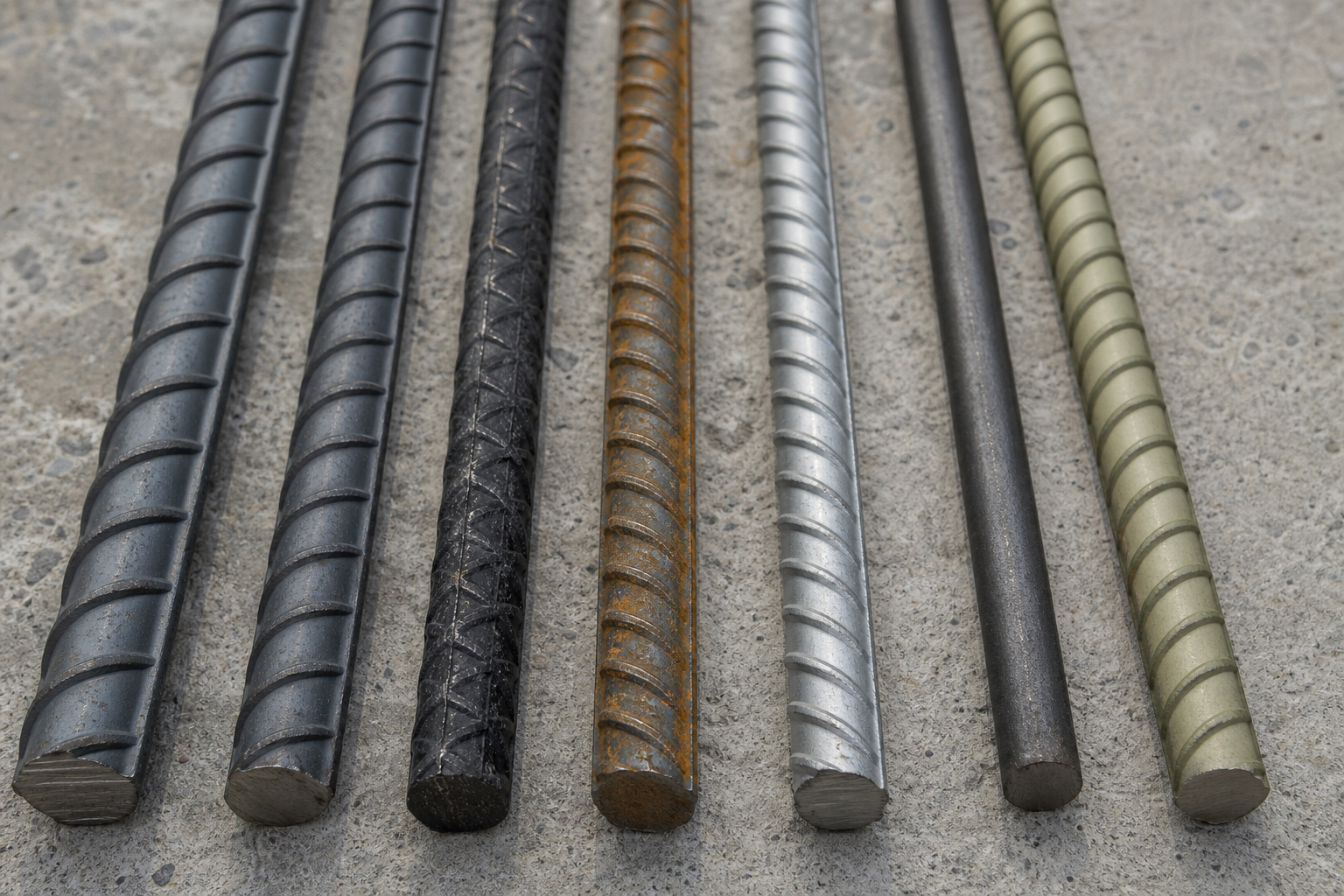
Below are the reinforcement types you will commonly see on infrastructure tenders and the procurement points to consider for each.
Grade 500W versus Grade 400W
- Grade 500W: Higher yield strength and often required where designers specify higher capacity or where contract documents call for Grade 500W for seismic, long spans or heavy load cases. Procurement point: request mill test certificates and heat or coil traceability showing conformity to the specified grade.
- Grade 400W: Acceptable for many standard elements and often more readily available. Procurement point: confirm designer acceptance where the tender allows alternatives and ensure MTRs match the specified grade.
Epoxy-coated rebar and corrosion resistance
Epoxy-coated rebar is specified where chloride exposure or de-icing salts threaten corrosion, for example on bridge decks or marine structures. When you specify epoxy-coated bars, add procurement and handling notes that require undamaged coating at delivery, inspection of repairs to the coating, and specific storage practices to avoid chipping. Require sample coated-bar coupons with the bid where visual confirmation of coating application is important.
Glass fibre reinforcing bars (GFRB)
GFRB can be attractive for its corrosion immunity and lower weight, but it has different mechanical properties and connection details than steel. Use GFRB where the design and contractor experience support it, and require manufacturer documentation for thermal behaviour, bond characteristics and approved connection systems. Insist on project-specific acceptance testing where GFRB is substituted for steel reinforcement.
Welded wire mesh
Welded wire mesh is specified for slabs and pavements in common gauges such as 6″ x 6″ at 6/6, 9/9 and 10/10. Match mesh gauge and sheet size to the slab design, and confirm manufacturers provide dimensional and tensile documentation. For procurement, request sample sheets if tolerances or flatness affect placement productivity.
Procurement and pre-purchase checklist you must run
Use the checklist below during the bid evaluation and pre-order review. Run each item as a firm requirement in the purchase order or contract submittals list.
- Specification completeness: Confirm exposure class, design grade, clear cover, splice types and any special coatings or surface treatments.
- Standards reference: Require the supplier to confirm compliance with referenced standards in the contract, including any provincial or ministry sections that apply to the project.
- Recognized product acceptance: Where ministry or provincial procurement rules apply, require proof that the product meets recognized product criteria or can be accepted via conformance evidence; consult the provincial recognized products list when needed (Recognized products list).
- Mandatory submittals: Mill test reports, material test reports, product approval listings, coating application records, shop drawings and proposed delivery windows.
- Sample testing: Require representative samples for unusual materials such as epoxy systems or GFRB, and define acceptance criteria in the contract.
- Traceability: Insist on heat or coil numbers and traceability documentation that link delivered bars to MTRs and factory tests.
- QA and factory controls: Request the supplier’s quality manual or relevant procedures for cutting, bending and coating controls.
- Insurance and warranties: Confirm contractual warranties for coatings, supply defects and replacement procedures for damaged goods.
Key submittals to require with a quote
- Mill test certificates and material test reports that identify heat or coil numbers.
- Product data sheets and certified statements for epoxy coatings or GFRB materials.
- Sample coated bar coupons and mesh sheet samples on request.
- Proposed shop drawings and bar schedules for review with a clear turnaround time.
- Delivery plan showing truck types, offloading methods and proposed delivery windows.
Traceability and testing to insist on
Traceability records must connect delivered items to MTRs and factory tests. For infrastructure contracts, document acceptance criteria in the purchase order and retain records for the life of the warranty. The NRC reinforcement checklist highlights which bar details and cover conditions to verify before concrete placement, and those items should be matched to your submittal and testing regime (NRC reinforcement in formwork checklist).
Shop drawing, fabrication and QA checklist
Shop drawings and fabrication are where specification and reality meet. Use this list to verify shop documentation and to set fabrication hold points.
- Bar schedules that match design drawings and include lengths, bends and required splice locations.
- Bending detail checks against design standards and specified hooks or development lengths.
- Splice and lap layouts that maintain specified overlap and location relative to supports.
- Clear documentation of concrete cover and spacer types; confirm spacer spacing and material compatibility with coatings.
- Handling rules for epoxy-coated bars and GFRB: protection during transport, storage, and in the fabrication shop.
- Fabrication QA records: cutting and bending logs, dimensional checks, and a record of rejected or repaired items.
Delivery, logistics and on-site assembly checklist

Coordination of delivery, offloading and storage is critical on urban and infrastructure sites where staging is constrained.
- Agree delivery windows and minimum notice for scheduling; include penalties or rebooking procedures for missed windows.
- Confirm truck types and offloading equipment, and record site access limitations such as time-of-day restrictions or lane closures.
- On-site storage plans for coated and GFRB materials to avoid UV or impact damage.
- Confirm the scope of supplier on-site assembly, tie teams or installation supervision if included in the contract.
- Document sign-off procedures for counts, visual inspection of coatings and conformance to shop drawings before the pour.
What to verify on delivery and before pour
- Counts and sheet/coil identification against the packing list and shop drawings.
- Visual condition of coatings, welded mesh flatness, and any damage to bars or bends.
- Bar markings and traceability tags that correspond to submitted MTRs.
- Temporary storage conditions and protection against weather or construction traffic.
- Field placement checks to confirm critical covers and clearances before formwork closure, referencing the NRC checklist for reinforcement in formwork (NRC checklist).
Supplier capability decision criteria and warning signs
Prioritise suppliers that demonstrate these capabilities:
- MTO-approved or able to demonstrate compliance with applicable ministry specifications.
- In-house estimating and detailing capacity so shop drawings and takeoffs align with fabrication.
- Fabrication capacity with documented QA processes and history of infrastructure projects.
- Dedicated trucking fleet and coordinated delivery planning for urban GTA sites.
- Documented traceability and a willingness to provide MTRs, sample tests and product listings.
Warning signs that should prompt further enquiry or rejection include missing MTRs, vague delivery plans, no documented QA procedures, refusal to provide coated-bar repair records, or inability to demonstrate recognized product acceptance where required.
Quick action steps and how to request quotes or shop drawings
- Prepare a concise RFQ package with specification excerpts, required submittals and delivery constraints, and send it to shortlisted suppliers.
- Require a firm quotation plus the mandatory submittals: MTRs, sample coupons for coatings, and proposed shop drawings with a defined review period.
- Review submittals, run spot tests if needed, confirm delivery windows and issue a purchase order that binds traceability and acceptance criteria.
To explore supplier capabilities and request shop drawings or a quote, review Dass Rebar’s reinforcing steel guide and contact their estimating team to discuss MTO projects, stock availability and coordinated delivery options (Dass Rebar reinforcing steel guide).
Frequently asked questions
How do I confirm a reinforcement product is acceptable for MTO or provincial infrastructure work?
Confirm acceptance by checking that the product meets the referenced ministry specification and by requesting traceable mill test reports and product approval evidence; provincial recognized products lists are a practical reference for qualifying materials (Recognized products list).
When should I specify epoxy-coated rebar instead of standard rebar for an infrastructure project?
Specify epoxy-coated rebar when the design exposure class indicates chloride risk from de-icing salts or marine exposure and when the expected service life requires enhanced corrosion protection. Add handling and inspection requirements to the procurement documents to protect the coating during transport and placement.
What documents should I require with a rebar quotation to prove traceability and compliance?
Require mill test reports identifying heat or coil numbers, material test reports for coatings or GFRB, product data sheets, proposed shop drawings and any recognized product listings or certifications deemed necessary by the owner or designer.
Can glass fibre reinforcing bars (GFRB) replace steel rebar on bridge decks or municipal infrastructure?
GFRB can be used where its mechanical properties and connection systems have been proven for the intended application. Require specific manufacturer documentation, project-specific acceptance testing and designer sign-off before substituting GFRB for steel in critical infrastructure elements.
What should site teams check on delivery before placing reinforcement for a pour?
Site teams should verify counts, bar and mesh condition, traceability markings matching MTRs, condition of coatings, and that shop drawings have been implemented as submitted; follow hold-point checks for cover and spacing per the NRC pre-pour checklist (NRC checklist).
Key takeaway: treat reinforcement procurement as a systems activity. Specification, traceability, fabrication quality and coordinated delivery must be managed together to achieve durable, compliant infrastructure outcomes.
Next step: to request a quote, shop drawings or to discuss MTO project requirements with a supplier that offers in-house estimating, detailing, fabrication and dedicated fleet delivery, contact Dass Rebar.