
Reinforcing bar suppliers provide engineered steel reinforcement, mesh, and related services that keep concrete structures strong, compliant, and on schedule. At 370 New Enterprise Way in Woodbridge, Dass Rebar supports Ontario contractors with MTO-approved materials, in-house estimating and detailing, fabrication, and coordinated delivery so steel shows up right and ready to install.
By Navjot Dass • Last updated: June 3, 2026
Start Here: How to choose your supplier
Choose a reinforcing bar partner by verifying compliance, stock availability, detailing accuracy, and delivery capacity. Look for MTO approval, common grades (400W/500W), in-house estimating/detailing, and a dedicated trucking fleet. Integrated providers reduce rework, protect pour windows, and align fabrication with your schedule.
This above-the-fold section gives you a fast, practical checklist you can act on today. It links each decision to an on-site outcome: faster placements, fewer surprises, and inspections that pass on the first visit.
- Verify compliance: MTO-approved status for infrastructure work; mill test reports (MTRs) and heat numbers for traceability.
- Confirm inventory: Common diameters in stock (10M, 15M, 20M) and welded mesh (6×6 6/6, 9/9, 10/10).
- Assess accuracy: In-house detailing with clear bar lists, bend schedules, and shop drawings.
- Check logistics: Dedicated fleet, staged drops by pour sequence, and site-ready bundles with tags.
- Ask for examples: Recent Ontario projects with references and sample drawings.
For a deeper primer before you call vendors, see our internal rebar supply guide and this broader reinforcing steel guide.
Quick Summary
Reinforcing bar suppliers that combine estimating, detailing, fabrication, delivery, and assembly under one roof reduce risk and save time. Dass Rebar offers 400W/500W steel, epoxy-coated options, GFRB, and welded mesh—with project management that aligns staging and deliveries to your pour calendar.
- Scope: Supply, fabrication, detailing, delivery, and on-site assembly.
- Materials: Grade 400W and 500W rebar, epoxy-coated rebar, Glass Fibre Reinforcing Bars (GFRB), 6×6 mesh (6/6, 9/9, 10/10).
- Capacity: Bundled stock and cut/bend production aligned to pour windows.
- Coverage: GTA and Ontario, coordinated from Woodbridge in the Regional Municipality of York.
- Track record: The Hawthorne Residences (Toronto), Hickory Terraces (Waterloo), The Grand at Universal City (Pickering).
Local considerations for Woodbridge
- Plan delivery windows around Highway 50 traffic; the yard sits near the Highway 50 – Zum Queen Stop EB, enabling quick east-west routing for morning drops.
- Stage priority bundles during peak summer pours; heat and labor demand rise in July–August, so order-lot organization avoids onsite sorting delays.
- Coordinate truck turns with site access near Fogal Rd / Highway 50; clear wayfinding speeds offloading and reduces flagging needs.
What are reinforcing bar suppliers?
Reinforcing bar suppliers source, fabricate, and deliver steel reinforcement to match structural drawings. The best vendors convert IFC plans into shop drawings, bend schedules, and tagged bundles, then stage drops to your pour sequence so crews place faster and inspectors sign off sooner.
At a practical level, a supplier is both a materials source and a coordination engine. The work spans takeoffs, detailing, cutting/bending, bundling, logistics, and on-site support for complex cages or mats.
- Materials scope: Black steel rebar (400W/500W), epoxy-coated rebar for chloride exposure, GFRB for corrosion resistance, and welded wire mesh (6×6 6/6, 9/9, 10/10).
- Drawings to steel: Shop drawings with bar marks; bend dimensions; lap splice, hook, and chair details.
- Traceability: Heat numbers and MTRs linked to each bundle for quality records.
- Assembly support: Tying crews for heavy mats, columns, or piers when schedules are tight.
In our experience supporting Ontario projects, the gains show up where it counts: fewer site stoppages, fewer RFIs, and cleaner inspection reports.
To explore steel basics before diving into vendor selection, review our steel rebar basics.
Why reliable rebar supply matters
Reliable rebar supply compresses critical path timelines by reducing rework, crane hours, and inspection delays. When bundles arrive cut, bent, and tagged per bar list, crews place faster, waste drops, and pour windows are protected—especially in Ontario’s compressed building season.
Good reinforcement logistics translate to field productivity. Consider a typical slab cycle: if detailing is accurate and drops match pour breaks, ironworkers can place and tie without re-sorting steel.
- Cycle-time impact: Clean bar lists speed mat placement and reduce reties.
- Quality control: Matching mill certs to bundles simplifies inspections.
- Seasonality: Ontario sites often compress work between April and November; punctual deliveries preserve those pour windows.
- Coordination: A single provider from estimating through delivery shortens feedback loops.
We’ve found that teams who align submittals, shop drawings, and delivery calendars early cut friction across the whole slab-to-core sequence.
For fast-delivery tactics, see our note on working with rebar wholesalers.
How the rebar supply process works
The process flows from takeoff to detailing, fabrication, and staged delivery. You’ll submit IFC drawings, receive shop drawings and bar lists, approve submittals, then receive tagged bundles scheduled to pours. Field crews tie mats and cages; inspectors check cover, splices, and traceability before concrete.
Here’s the practical, step-by-step flow we use to keep projects moving and documentation tight.
- Scope + takeoff: We quantify steel from IFC drawings and identify laps, hooks, and splices.
- Detailing + submittals: Shop drawings, bend schedules, and bar lists go out for approval.
- Fabrication: Cutting and bending to bar marks; common sizes include 10M (≈11.3 mm), 15M (≈16.0 mm), 20M (≈19.5 mm).
- QA + traceability: MTRs and heat numbers tied to bundles matching approved submittals.
- Staged delivery: Bundles arrive sequenced to pours; mesh variants include 6×6 6/6, 9/9, and 10/10.
- Field assembly: Tying mats and cages with chairs/spacers set to maintain cover.
- Inspection + pour: Cover, lap, and tag checks; concrete placement proceeds on sign-off.
For a fuller walkthrough with checklists, our supplier guide for Ontario explains documents, approvals, and common inspection checkpoints.
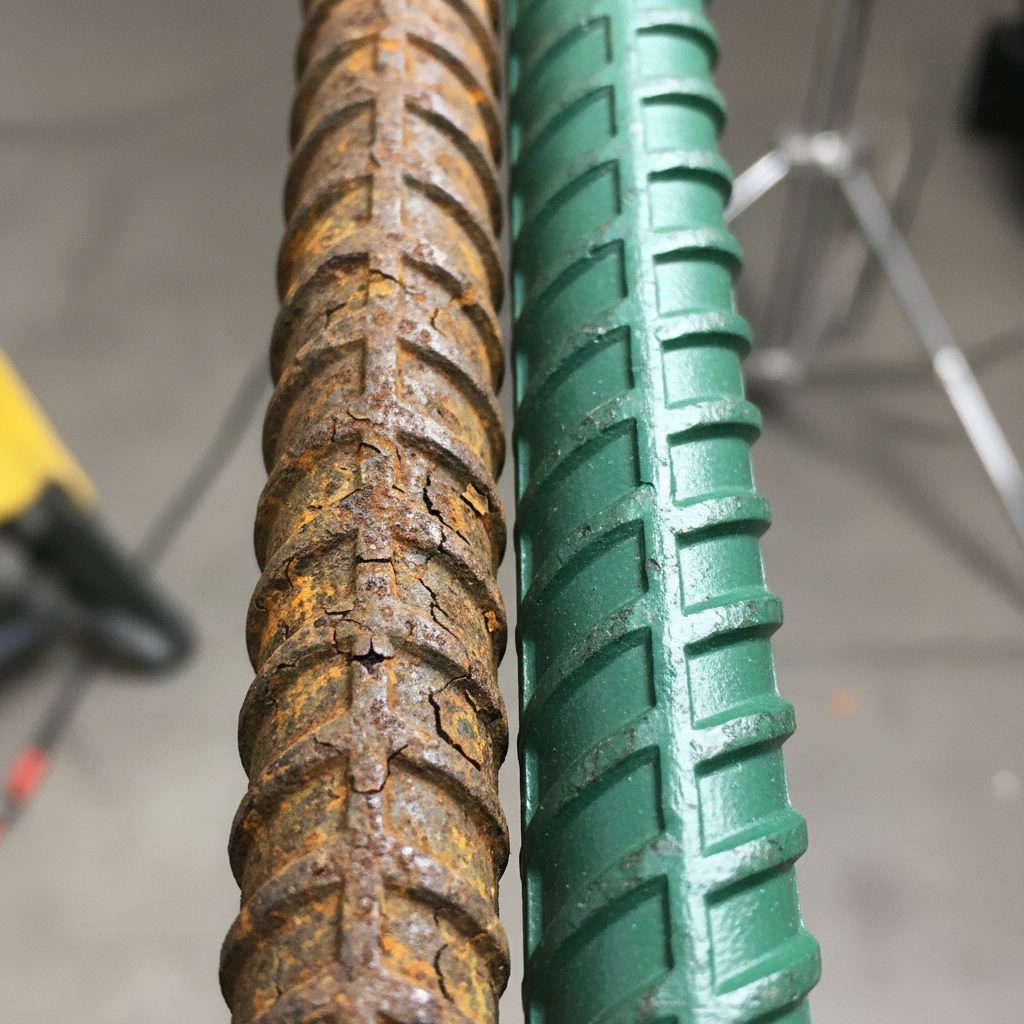
Types of reinforcement and when to use them
Use black steel rebar (400W/500W) for most structural work, epoxy-coated steel in chloride exposure, GFRB where corrosion or conductivity is a concern, and welded wire mesh for slabs and pavements. Match material to environment, loads, and detailing complexity.
The right bar type balances performance, constructability, and inspection clarity. Here’s a quick, field-tested reference.
Common materials
- Black steel rebar: Typical for foundations, cores, and beams; 400W and 500W correspond to ≈400 MPa and ≈500 MPa yield.
- Epoxy-coated steel: Adds corrosion resistance for deicing salt or marine splash zones.
- Glass Fibre Reinforcing Bars (GFRB): Non-metallic; won’t rust; roughly a quarter the weight of steel—useful around utilities or corrosive exposure.
- Welded wire mesh (WWM): 6×6 at 6/6, 9/9, or 10/10 gauges; speeds slab reinforcement.
Selection cues
- Exposure class: Chloride-prone? Prefer epoxy-coated or GFRB per design.
- Detailing density: Tight congestion may favor smaller diameters or mesh in combination.
- Inspection clarity: Ensure tags, bar marks, and MTRs are easy to trace back.
- Handling constraints: Long runs and elevated decks benefit from lighter bars or pre-tied panels.
For definitions, diagrams, and field tips, our reinforcing bar guide expands on bar marks, hooks, and anchorage details.

Material comparison at a glance
| Material | Typical use | Strength class | Standout benefit | Watch-outs |
|---|---|---|---|---|
| Black steel (400W/500W) | Foundations, cores, beams | ≈400–500 MPa yield | Widely available; easy to inspect | Needs cover/clearances managed |
| Epoxy-coated steel | Deicing/marine exposure | Base steel grade | Improved corrosion resistance | Coating damage during handling |
| GFRB | Corrosive or non-conductive needs | Project-specific | Lightweight; won’t rust | Different lap/anchorage behavior |
| Welded wire mesh | Slabs, pavements | Gauge-based | Faster placement | Limited for concentrated loads |
How to evaluate reinforcing bar suppliers
Evaluate reinforcing bar suppliers on five pillars: compliance, accuracy, capacity, logistics, and proof. Confirm MTO approval, inspect sample shop drawings, ask about lead times by diameter/coating, verify trucking fleet capacity, and request recent Ontario references.
Here’s a concise framework we use with GC and concrete teams during preconstruction.
- Compliance: MTO approval where applicable; MTRs tied to heat numbers by bundle.
- Accuracy: In-house detailing, clear bend schedules, and clash-aware bar lists.
- Capacity: Stocked 10M/15M/20M; cut/bend throughput that fits your pour rhythm.
- Logistics: Dedicated trucks; GPS dispatch; staging by elevation and pour breaks.
- Proof: Ontario project references plus sample shop drawings.
After shortlisting, align on communication cadence and RFI turnaround. That single agreement often removes days from the schedule across a multi-level build.
For deeper fabrication pointers, tap our fabrication best-practices guide.
Best practices that protect your schedule
Lock submittals early, approve shop drawings with field input, and sequence deliveries to pours. Color-code bundles by elevation, stage mesh near lifts, and pre-tag bars. These habits cut placement time and reduce reties on congested decks.
Planning and submittals
- Target dates: Work backward from pour dates to set drawing approval and fabrication start.
- Field alignment: Have foremen review shop drawings to catch congestion or access issues.
- Bar supports: Specify chairs/spacers and cover (e.g., 40–75 mm typical depending on element) in submittals.
Delivery and staging
- Bundle logic: Tag by area, elevation, and bar mark; stage ahead of cranes or hoists.
- Mesh placement: Use 6×6 6/6 or 9/9 panels to speed slab work; tie laps as designed.
- Inspection prep: Keep MTRs at the gate; check tags against approved lists on arrival.
On-site assembly
- Pre-tied panels: Where feasible, preassemble cages to shrink on-deck tying time.
- Lap verification: Confirm splice class and lap lengths before pour; mark any field changes.
- Safety sync: Coordinate crane picks, hoist windows, and exclusion zones with daily huddles.
These routines sound simple, but we see them save hours per deck, especially on repetitive floors where rhythm compounds.
Tools and resources you’ll actually use
Use digital takeoff, clash-aware detailing, and bar-listing tools to reduce waste. Organize submittals around project specs, then lock a delivery calendar that reflects site access and traffic realities across the GTA.
- Digital takeoff: Produces accurate quantities and early RFI discovery.
- Bar-listing software: Cuts sorting time; clean CSVs feed fabrication.
- Delivery calendar: Map windows against lane restrictions and crane availability.
- Traceability logs: Keep heat numbers/MTRs tied to each bundle for inspection.
For structural system context, see this steel framing system overview to align trades and sequence hoisting with reinforcement work.
Free coordination review: Share your IFC set and target pour dates. Our in-house estimating, detailing, and logistics team will flag congestion risks and map deliveries to your calendar.
Backed by 40+ years of Ontario construction experience.
Case studies from Ontario projects
Ontario projects run smoother when detailing, fabrication, and delivery operate as one workflow. Dass Rebar’s portfolio—Toronto, Waterloo, and Pickering—shows faster placements, cleaner inspections, and tighter staging when one team owns the reinforcing sequence end to end.
The Hawthorne Residences, Toronto
- Challenge: Dense core reinforcement risked congestion and reties.
- Approach: Early shop drawing reviews with field leads; staged 15M/20M bundles by elevation.
- Result: Cleaner inspections; consistent cycle times floor-to-floor.
Hickory Terraces, Waterloo
- Challenge: Compressed schedule with multiple slab pours per week.
- Approach: Mesh selection (6×6 6/6) to speed placement; pre-tagged bars matched to pour breaks.
- Result: Reduced on-deck tying and fewer RFI delays.
The Grand at Universal City, Pickering
- Challenge: Coordination across trades with complex rebar cages.
- Approach: Pre-assembly for heavy elements; synchronized trucking and crane windows.
- Result: Predictable delivery rhythm and first-pass inspections.
For why timing matters so much to schedules, here’s more on timely rebar delivery.
Frequently Asked Questions
Most buyers ask about compliance, materials, and delivery rhythm. Vet MTO approval and traceability, confirm 400W/500W and mesh availability, and map deliveries to your pour calendar. Early alignment on these three points prevents most onsite delays.
How early should I involve a reinforcing bar supplier?
Bring your supplier in during preconstruction. Early input improves constructability, clarifies lap and hook details, and prevents congestion. Precon reviews often surface sequencing issues that are cheap to fix on paper and expensive to fix in the field.
What’s the difference between 400W and 500W?
They denote approximate yield strengths: about 400 MPa for 400W and about 500 MPa for 500W. Your engineer specifies which grade to use based on loads, exposure class, and anchorage details. Suppliers keep both grades available for common diameters.
Is welded wire mesh a full replacement for rebar?
Not typically. Mesh is ideal for slabs and pavements where uniform distribution works. Concentrated loads, anchorage zones, and heavy reinforcement often require deformed bars. Your structural drawings will indicate where each product applies.
Do suppliers help with on-site assembly?
Yes, many suppliers offer tying crews for complex mats and cages. Confirm scope, crew availability, and how assembly coordinates with your formwork and crane plan. This avoids last-minute conflicts and keeps inspections smooth.
How do I verify material traceability?
Each bundle should carry a tag with bar marks linked to a heat number. Mill test reports (MTRs) match those numbers. Keep copies with deliveries and cross-check against approved submittals before placement.
Key takeaways and next steps
Pick a single, integrated partner for estimating, detailing, fabrication, delivery, and assembly. Align submittals, approve shop drawings with field input, and stage deliveries to pours. These three moves protect your schedule and reduce rework.
- Choose integration: One provider reduces risk and speeds decisions.
- Lock logistics: Delivery calendars aligned to pours protect critical paths.
- Document control: Traceability and approved drawings streamline inspections.
Ready to map your reinforcing plan to actual pour dates? Share your drawings and schedule with our team in Woodbridge. We’ll return a coordinated plan tailored to GTA and Ontario jobsite realities.
Looking to extend materials planning to allied scopes? This steel scrap value guide can inform your site recycling plan alongside reinforcement staging.
Book a coordination review in Woodbridge: We’re at 370 New Enterprise Way and serve projects across the GTA and Ontario with a dedicated fleet and MTO-approved materials.