
Last updated: October 2026
By Dass Rebar • Refreshed for the next publication cycle
On a concrete project, material flow is part of the production plan, not an administrative task that happens beside it. A missing bar mark can stop an installation crew, while an incorrectly staged bundle can consume crane time and create an avoidable handling risk. Good construction site material management connects the drawings, fabrication shop, truck, laydown area, and installation crew into one visible sequence.
This guide focuses on reinforcing steel, welded wire mesh, epoxy-coated rebar, Glass Fibre Reinforcing Bars (GFRB), embeds, and related accessories. Dass Rebar supports Ontario projects from its Woodbridge operation at 370 New Enterprise Way with in-house estimating, detailing, fabrication, project management, delivery, and on-site assembly support. The same principles also apply to other high-volume construction materials.
What construction site material management means
Construction site material management is the controlled movement of materials from estimating and procurement through fabrication, delivery, receiving, staging, issuance, installation, and closeout. The objective is simple: crews should be able to identify what has arrived, know where it belongs, access it safely, and confirm what remains.
For rebar, that control begins with the approved drawings and bar list. It continues through shape fabrication, bundle identification, shipping documentation, delivery timing, laydown, and installation by pour or zone. Each handoff is an opportunity either to preserve information or to lose it.
The six connected parts of the process
- Takeoff and estimating: Quantify bar marks, lengths, weights, mesh areas, accessories, and likely pour requirements.
- Detailing: Translate design information into constructible bar shapes, marks, schedules, placement drawings, and clarification items.
- Rebar fabrication: Cut, bend, label, and bundle material according to the approved sequence rather than simply producing it in bulk.
- Rebar delivery: Match truck timing, load composition, access, unloading, and crane availability to the site plan.
- Receiving and staging: Check the shipment against its manifest, protect the material, and place it where the installation team can use it.
- Issuance and closeout: Track what moves to the deck or foundation, investigate variances, and record lessons for the next pour.
A coordinated supplier can reduce the number of disconnected handoffs. It cannot remove the contractor’s responsibility for site planning, safe storage, inspection, and compliance with the contract documents, but it can make the information and material flow easier to manage.
Why it matters for concrete and rebar work
Reinforcing steel sits on the critical path between formwork readiness and concrete placement. If a crew is waiting for a missing bar, sorting mixed bundles, or moving steel several times before installation, the impact may extend beyond the steel subcontractor. Formwork, inspection, pumping, finishing, hoisting, and follow-on trades can all be affected.
Strong material control protects four project outcomes:
- Schedule: Deliveries are aligned with pour breaks, crane windows, access restrictions, and lookahead planning.
- Productivity: Kitted bundles and readable tags reduce searching, sorting, and unnecessary travel.
- Quality: Grade, size, coating, length, shape, and placement information remain identifiable through installation.
- Safety: Fewer rehandles mean fewer opportunities for struck-by incidents, strains, trips, and unstable storage.
For steel-reinforcement work, technical requirements should come from the current contract documents and applicable owner specifications. MTO materials and placement references may include OPSS 1440 and OPSS.PROV 905, but the supplied OPSS.PROV 905 reference is explicitly marked as a draft. Project teams should therefore verify the current owner specification, approved drawings, inspection requirements, and contract amendments before treating a reference as governing.
A rebar material management workflow from takeoff to pour
The most reliable workflow starts before the first truck is loaded. Each stage should create information that the next stage can use without reinterpreting the whole package.
1. Build a takeoff that reflects the construction sequence
Do not treat the estimate as only a purchasing total. Break quantities into levels, zones, footings, walls, columns, slabs, or other meaningful installation areas. Identify long bars, congestion areas, couplers, embeds, mesh, coating requirements, and items with long lead times.
A drawing overlay or marked-up pour plan can connect each bar mark to a physical location. Before releasing material, compare the takeoff with the latest structural drawings, revisions, addenda, and approved RFIs. Dass Rebar’s rebar estimating guide provides a practical starting point for checking quantities and bar information.
2. Make detailing useful to the field
Shop drawings and bar lists should use a consistent mark system and make the relationship between shape, location, quantity, and pour clear. Flag ambiguities early rather than allowing a fabricator or installer to make assumptions under schedule pressure.
Separate items such as epoxy-coated bars, mechanical connections, special bends, and unusually long lengths in the package. The rebar detailing guide explains how consistent marks and clear placement information can reduce interpretation at the jobsite.
3. Fabricate and kit to the next installation activity
Rebar fabrication is more useful when it produces installation-ready groups instead of anonymous inventory. Cut and bend approved bars, then bundle them by pour, zone, element, or another sequence the crew recognizes. Use durable tags with the mark, quantity, length or shape reference, destination, and any special handling note.
Keep different lengths and coatings distinct. Pre-sorting common 10 m, 15 m, and 20 m bars can save field time, but the site team should confirm that the bundle arrangement matches the approved drawings and lifting plan. The Ontario rebar fabrication guide covers the relationship between fabrication decisions and field installation.
4. Plan rebar delivery around site capacity
A delivery schedule should show more than a date. Include the pour or zone, load contents, expected arrival window, unloading location, crane or telehandler requirement, site contact, access restrictions, and recovery plan if the site is not ready.
Confirm the next day’s loads against the two-week lookahead and the next 48 hours of work. A dedicated contact should be able to hold, redirect, or resequence a load when formwork, inspection, weather, or access changes. The rebar supply guide offers additional planning considerations for coordinating supply with site demand.
5. Receive against the shipping information
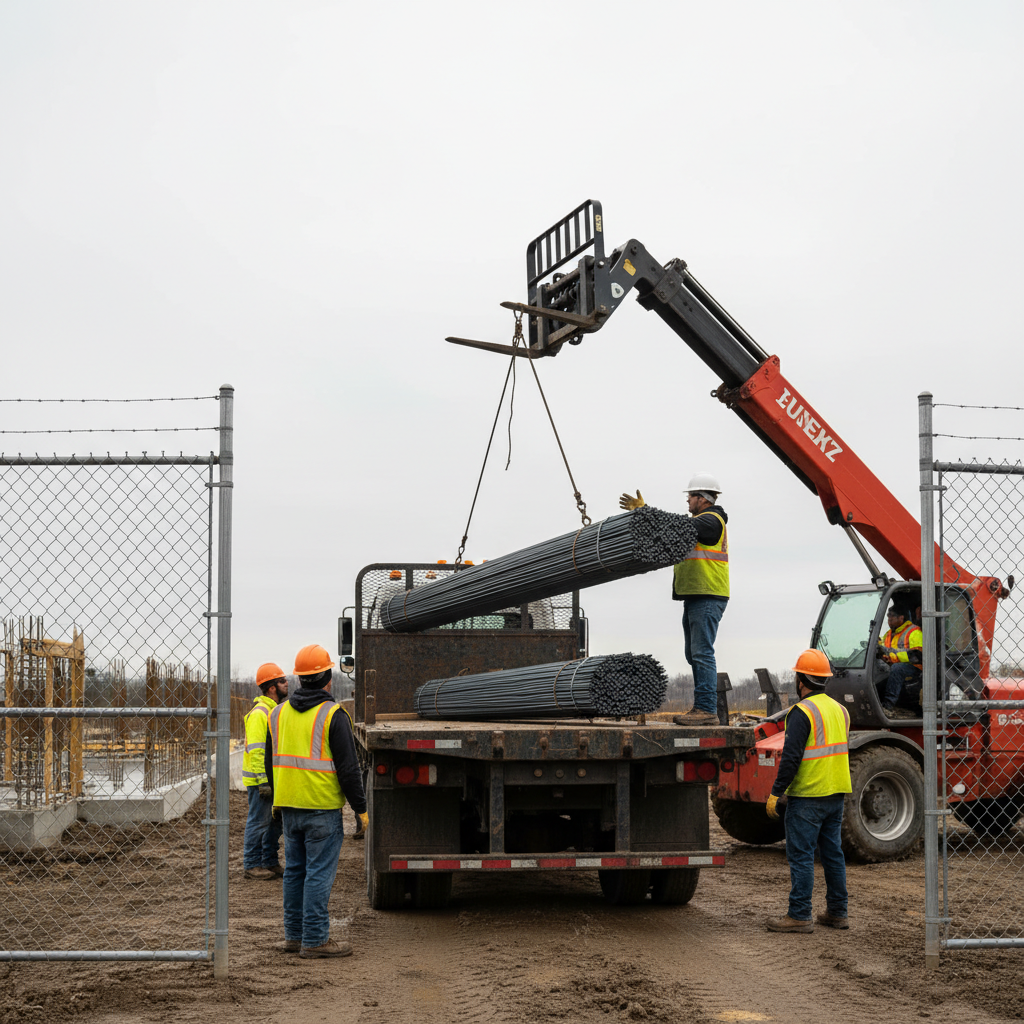
Assign a trained receiver or material lead. Before unloading, confirm that the truck can access the planned area and that the ground, dunnage, lifting equipment, and traffic controls are ready. Compare bundle tags and the shipping list with the expected load, then record shortages, damage, substitutions, or unplanned extras immediately.
Industry handling guidance notes that reinforcing bars are shipped for specific parts of a structure and that a shipping list or manifest accompanies the shipment. That information should remain with the material rather than being discarded at the gate.
6. Stage for installation, not merely storage
Place bundles on stable dunnage, off the ground, with enough separation to identify them without climbing over adjacent material. Keep access and emergency routes clear. Stage the next work package close enough to reduce travel while preserving lifting clearances and safe pedestrian routes.
Mesh types such as 6 x 6 at 6/6, 9/9, and 10/10 should have separate, clearly marked stacks. Protect edges and avoid mixing sheets that look similar from a distance. Store epoxy-coated bars in a way that limits impact and coating damage, using handling methods appropriate to the project requirements and manufacturer guidance.
7. Issue and reconcile every shift
Use a bundle ID, tag, QR label, or tally sheet to record what moves from the laydown area to the work face. The method can be simple, but it must be consistent. Reconcile the issued quantity with the installation plan before the end of the shift so a shortage is found while recovery options still exist.
Record variances by mark rather than writing only “short steel.” A mark-level record can distinguish a fabrication issue, receiving error, drawing revision, misplaced bundle, or unplanned field change. That makes the next delivery more accurate.
Storage, receiving, and safety controls
Storage is part of material quality and worker protection. Ontario guidance on material and spoils placement emphasizes that materials must be placed and stored so they do not endanger workers, with attention to stability, movement, allowable loads, and the work area. Review the applicable requirements for the specific activity and site rather than relying on a generic storage diagram.
Use a controlled laydown layout
- Assign locations by pour, zone, or material family and show them on a simple site map.
- Keep bundles elevated on suitable dunnage and prevent rolling or unstable stacking.
- Separate standard, epoxy-coated, GFRB, mesh, embeds, and accessories with visible labels.
- Maintain crane pick paths, vehicle routes, pedestrian access, fire access, and inspection areas.
- Protect tags from weather and replace unreadable labels before the material moves.
Control damage and traceability
At receiving, photograph or document damaged bundles and notify the responsible project contact. Do not quietly place questionable material into an active installation stack. Where heat numbers, mill certificates, coating records, or other traceability documents are required by the contract, connect that information to the bundle or shipment record.
For epoxy-coated steel, use handling equipment and lifting methods that avoid unnecessary impact or abrasion. Any repair, acceptance, or replacement decision should follow the project requirements rather than an improvised site rule.

Tracking methods that crews will actually use
Material tracking does not need to begin with a complex software implementation. A shared spreadsheet, printed tally, bundle tags, and a daily variance review can provide useful control when the project team uses them consistently. Larger or more repetitive projects may benefit from QR labels or an integrated platform, but technology cannot correct unclear marks or an unreliable receiving process.
| Method | Useful when | Control to maintain |
|---|---|---|
| Paper tally | Small work areas or short sequences | Legible entries, one owner, end-of-shift reconciliation |
| Shared spreadsheet | Several supervisors need common visibility | Version control, bundle IDs, and protected formulas |
| QR or barcode labels | Many repeated bundles and frequent movements | Readable labels, working devices, and a backup process |
| Integrated platform | Multiple projects, yards, or complex inventory | Configured status fields and user adoption |
Set practical operating targets
Targets should help a team find problems, not create unsupported promises. A contractor may choose to monitor on-time arrivals within an agreed window, daily count agreement, damage incidents, rehandles, open shortages, and scrap by weight. The correct baseline depends on project size, design changes, access, weather, and the agreed scope.
For a project-specific review, compare the bar list, delivery windows, and installation zones rather than applying a universal percentage. A target such as 98% count agreement can be a useful internal control, but it should be measured consistently and investigated when it is missed.
Planning for Ontario project conditions
Local conditions influence the material plan even when the technical package is the same. A Woodbridge or wider GTA site may have restricted truck access, limited laydown, active neighbouring work, and narrow crane windows. Traffic near major corridors can make a missed slot expensive, while winter weather, rain, and summer heat can affect access, tags, dunnage, and protective coverings.
Build a recovery option into the schedule. That may mean a reserved delivery slot, an alternate unloading area, a confirmed site contact, or a short-term hold at the fabricator. Do not send a load simply because it is complete if the site cannot receive it safely or the material will block another trade.
Project examples such as The Hawthorne Residences in Toronto, Hickory Terraces in Waterloo, and The Grand at Universal City in Pickering illustrate different planning pressures: constrained urban access, separated mesh requirements, and long-bar sorting. The operational lesson is not that one layout fits every project. It is that the delivery, staging, and installation sequence should be designed around the actual site.
Materials that deserve close control
Reinforcing steel is the primary focus, but several related products can create the same type of delay if they are not connected to the pour plan.
- Grade 500W and 400W rebar: Keep sizes, shapes, marks, lengths, and destinations identifiable. Do not combine similar-looking bundles without clear separation.
- Epoxy-coated rebar: Protect the coating during storage and handling, and follow the project’s acceptance and repair requirements.
- Welded wire mesh: Separate 6 x 6 6/6, 6 x 6 9/9, and 6 x 6 10/10 configurations. Label stacks on more than one visible side.
- GFRB: Store and handle according to the manufacturer’s instructions and project requirements, with protection from damage and unnecessary bending.
- Embeds, couplers, and accessories: Use small, labelled bins or kits by pour so they are available when the reinforcing crew needs them.
Teams needing a product overview can review the steel rebar guide. For mesh selection, the wire mesh types and uses guide can help keep similar configurations from being substituted or mixed without review.
How the supplier and site team should coordinate
Material management works best when responsibilities are explicit. The supplier should know the approved information, fabrication sequence, required documentation, delivery constraints, and escalation contact. The site team should communicate readiness, access, unloading capacity, installation priorities, changes, and rejected or damaged material promptly.
A short daily huddle can cover five questions: What is being installed today? What must arrive next? Where will it be unloaded? What has changed? Which shortage or variance needs an owner before the shift ends? These questions are more valuable than a schedule that nobody updates.
For teams comparing service scopes, the estimating services overview explains how front-end estimating can connect with later detailing and supply decisions. A coordinated workflow is particularly helpful when design revisions and pour changes are frequent.
Common failures to avoid
Buying by total weight alone
A total tonnage figure does not tell the field team what belongs in the next pour. Break the requirement into usable installation packages and preserve the relationship between quantity and location.
Fabricating too far ahead of the work
Early production can fill the yard, hide changes, and increase handling. Fabricate against an agreed sequence and confirm that the site has a safe place to receive the next package.
Using unreadable or inconsistent tags
A tag that cannot be read from the ground is not a useful control. Standardize size, placement, colour conventions, and required fields, then replace damaged tags before the bundle moves.
Recording shortages without investigating them
A shortage log is only useful if someone determines whether the cause was a missed quantity, a misplaced bundle, a drawing revision, a receiving error, or an installation change. Assign an owner and a resolution date.
Treating storage as an afterthought
Unplanned storage causes double-handling and can create stability, access, and inspection problems. Confirm the laydown plan before the truck arrives, not after the bundles are on the ground.
Frequently asked questions
What is the best first step in construction site material management?
Start by mapping the next one or two pours and linking each required material package to a zone, date, delivery window, and responsible person. Then compare the plan with the latest drawings, bar lists, site access, laydown capacity, and installation sequence. This exposes missing information before it becomes a field delay.
How can rebar delivery reduce rehandling?
Schedule loads by pour or zone, label bundles clearly, and unload them into planned locations on stable dunnage. Confirm that the crane, access route, and receiving crew are ready before dispatch. A delivery is only efficient when the material can move from truck to useful staging without an unnecessary intermediate stack.
Should rebar fabrication be organized by pour?
In most multi-pour projects, organizing fabrication and bundling by pour, zone, or structural element makes identification and installation easier. The exact grouping should follow the approved drawings and the crew’s lifting and placement method. Separate special coatings, lengths, shapes, and accessories so similar-looking material cannot be confused.
Do small projects need digital material tracking?
Not necessarily. A clear bar list, durable tags, a receiving checklist, and a daily tally can be sufficient when the project is small and one person owns the records. Digital tools become more useful as bundle volume, site count, revision frequency, or coordination complexity increases.
Make material flow part of the pour plan
Construction site material management is the practical connection between what the drawings require and what the installation crew can use safely and on time. For rebar work, the strongest process combines accurate takeoffs, clear detailing, sequence-based rebar fabrication, planned rebar delivery, protected staging, and disciplined issue tracking.
Dass Rebar supports Ontario contractors with Grade 500W and 400W reinforcing steel, epoxy-coated options, GFRB, welded wire mesh, estimating, detailing, fabrication, delivery, project management, and on-site assembly. Start your next review with the next pour: identify the required marks, confirm the staging location, assign the receiving owner, and agree how variances will be closed.
Plan a material-flow review
For a project-specific discussion of bar lists, fabrication sequence, mesh separation, staging, and delivery windows, contact Dass Rebar and bring the next pour plan to the conversation.