
GFRP construction refers to using glass fiber reinforced polymer reinforcement instead of conventional steel in concrete. These non-corrosive bars deliver high tensile strength with low weight, eliminating rust-driven repairs and extending service life. For Woodbridge contractors balancing speed and durability, GFRP helps meet timelines while reducing maintenance risks in chloride, moisture, and deicing environments.
By Navjot Dass | Last updated: June 25, 2026
Above-the-Fold: Hook + TOC
GFRP construction replaces steel rebar with non-corrosive, high‑strength composite bars that speed installation and extend service life. Teams gain faster handling, no rust, and predictable durability in salt and moisture. Use this guide to decide where GFRP fits, how to design it, and how to install it right the first time.
If you lead concrete work in the GTA, youre juggling timelines, inspections, and durability risks. Heres how glass fiber reinforced polymer reinforcement (GFRP) fits into real jobsite decisionsfrom design to installationwith examples grounded in Dass Rebars Ontario experience.
- What GFRP is and where it excels
- Design basics, codes, and detailing differences
- Field installation checklists that prevent rework
- When GFRP beats epoxy-coated steeland when steel still wins
- Ontario-ready workflows: estimating, fabrication, delivery, and assembly
- Summary
- What Is GFRP Construction?
- Why GFRP Matters
- How GFRP Reinforcement Works
- Types, Methods, and Approaches
- Best Practices (Design, Detailing, Install)
- Tools and Resources
- Case Studies and Examples
- FAQ
- Conclusion & Key Takeaways
- Where to go next
Summary
GFRP rebar is a corrosion-proof alternative to steel that offers high tensile capacity at a fraction of the weight. It simplifies handling, prevents rust spalls, and supports long-life infrastructure. Use it in decks, parking structures, seawalls, and chemical exposure zones while following FRP-specific design and detailing rules.
Heres the short version, tailored for Ontario sites and Woodbridge schedules:
- Stronger than it looks: Typical GFRP bar tensile strength ranges about 12010 ksi, with linear elastic behavior to rupture. Design is serviceability-governed, not yield-based.
- Zero rust: Chlorides dont attack GFRP, avoiding the crackspallrehab cycle that often follows winter deicing exposure on decks and slabs.
- Light and fast: Weight can be roughly one-quarter of steel, enabling rapid placement and fewer crew fatigue slowdowns.
- Thermally non-conductive: Reduced thermal bridges in specialty slabs and enclosures.
- Design nuances: Lower modulus than steel affects deflection and crack control; spacing and bar size choices matter.
- Ontario-ready logistics: Dass Rebar supports takeoffs, detailing, fabrication, coordinated rebar delivery, and on-site assembly to keep pours on time.
Local considerations for Woodbridge
- Plan deliveries to avoid peak congestion near Queen St / Highway 50. Dass Rebars trucking team sequences drops to match formwork progress.
- Winter pours introduce thermal gradients; GFRPs non-conductive nature helps, but curing protection still matters in JanuaryMarch.
- Coordinate lot access around Fogal Rd / Highway 50 when staging mats and chairs; lighter GFRP allows smaller equipment footprints.
What Is GFRP Construction?
GFRP construction uses glass fiber reinforced polymer bars and shapes as reinforcement in concrete. These composite bars dont corrode, weigh far less than steel, and deliver high tensile capacity. Design relies on FRP-specific provisions, and installation uses non-metallic accessories to protect performance.
GFRP stands for glass fiber reinforced polymer. In reinforced concrete, GFRP bars carry tension while concrete handles compression. Unlike steel, GFRP never rusts, so chloride-laden environments (like parking decks and bridge slabs) avoid rebar expansion, cracking, and spalling.
- Material makeup: E-glass fibers embedded in a polymer matrix, often sand-coated for bond. Bars are pultruded and ribbed to improve mechanical interlock.
- Behavior: Linear-elastic to rupture (no yield plateau). This shapes serviceability checks, crack width limits, and deflection control.
- Thermal/electrical: Non-conductive and non-magneticuseful around MRI rooms, substations, and sensitive equipment.
- Durability: Immune to chloride corrosion; compatible with alkali-resistant mixes and standard concretes when detailing and cover are correct.
Where does this matter? In our Ontario work, owners focus on lifecycle durability. When salt exposure is certain, GFRP helps extend the time between resurfacing cycles. Teams also like its handling: crews move bundles faster, and crane picks are lighter, which supports aggressive pour windows.
For a deeper primer on reinforcement options, see our reinforcing steel complete guide and our focused fiberglass rebar guide.
Why GFRP Matters for Modern Projects
GFRP reduces future repairs by eliminating steel corrosion while improving constructability with lighter bundles and faster placement. Owners gain longer service life; contractors gain productivity and predictable schedules. The result is resilient infrastructure and fewer disruptions in salt and moisture exposure zones.
Why choose GFRP now? Three forces are converging: harsher freezethaw and deicing cycles, rising owner focus on lifecycle uptime, and tight labor markets. Non-corrosive reinforcement directly addresses all three.
- Lifecycle durability: Eliminating rust prevents expansive cracking and delamination. Many owners now specify non-metallic top mats in decks to prolong resurfacing intervals.
- Constructability: One lift can handle more linear feet; bars snap less from handling because theyre lighter. Crews often report quicker tie cycles with plastic ties and non-metallic chairs.
- Safety and access: Lighter bundles ease staging in tight urban cores and reduce fatigue over long shifts.
- Specialty performance: Non-magnetic, low-conductivity behavior fits hospitals, labs, and energy facilities.
Weve found Ontario teams appreciate predictable pours. When we coordinate rebar supply, in-house detailing, and trucking windows, the lighter GFRP loads help keep road maneuvers efficient and crane time short. That net gain shows up as steadier schedules exactly what superintendents want.
How GFRP Reinforcement Works
GFRP bars provide high tensile strength with lower modulus than steel, so design emphasizes serviceability: deflection, crack widths, and bar spacing. Bond is achieved with sand coatings and rib geometry, and construction uses non-metallic chairs, ties, and isolators to preserve performance.
Think of GFRP as linear-elastic reinforcement with no yield plateau. Typical tensile strengths often exceed 120 ksi, but the modulus is lower than steel (on the order of 68 Msi versus steels ~29 Msi). That shifts attention to stiffness and spacing in slabs and beams.
- Bond and development: Sand-coated surfaces and ribs deliver reliable bond. Development lengths differ from steel; always check FRP tables and detailing notes.
- Anchorage: Hooks are uncommon; mechanical anchors or extended development are typical. GFRP stirrups exist but observe bend radius limits.
- Thermal compatibility: Coefficients near concrete reduce internal stress swings; still, joint detailing matters for temperature gradients.
- Fire considerations: Cover and protection strategies are project-specific. Coordinate with the EOR for required fire ratings.
Our detailing team emphasizes clear shop drawings. We annotate non-metallic chairs, plastic spacers, isolators around penetrations, and bar mark callouts to prevent field guesswork. When we pair those drawings with coordinated rebar fabrication, crews report fewer RFIs and smoother inspections.
Types, Methods, and Approaches
GFRP comes as straight bars, bent bars within radius limits, stirrups, and pre-tied mats. Choose based on exposure class, desired service life, and structural behavior. Many teams combine GFRP top mats with steel bottom mats, or use full-GFRP cages where corrosion risk is extreme.
There isnt one one-size. Your approach depends on exposure, structural demand, and construction flow.
Common configurations
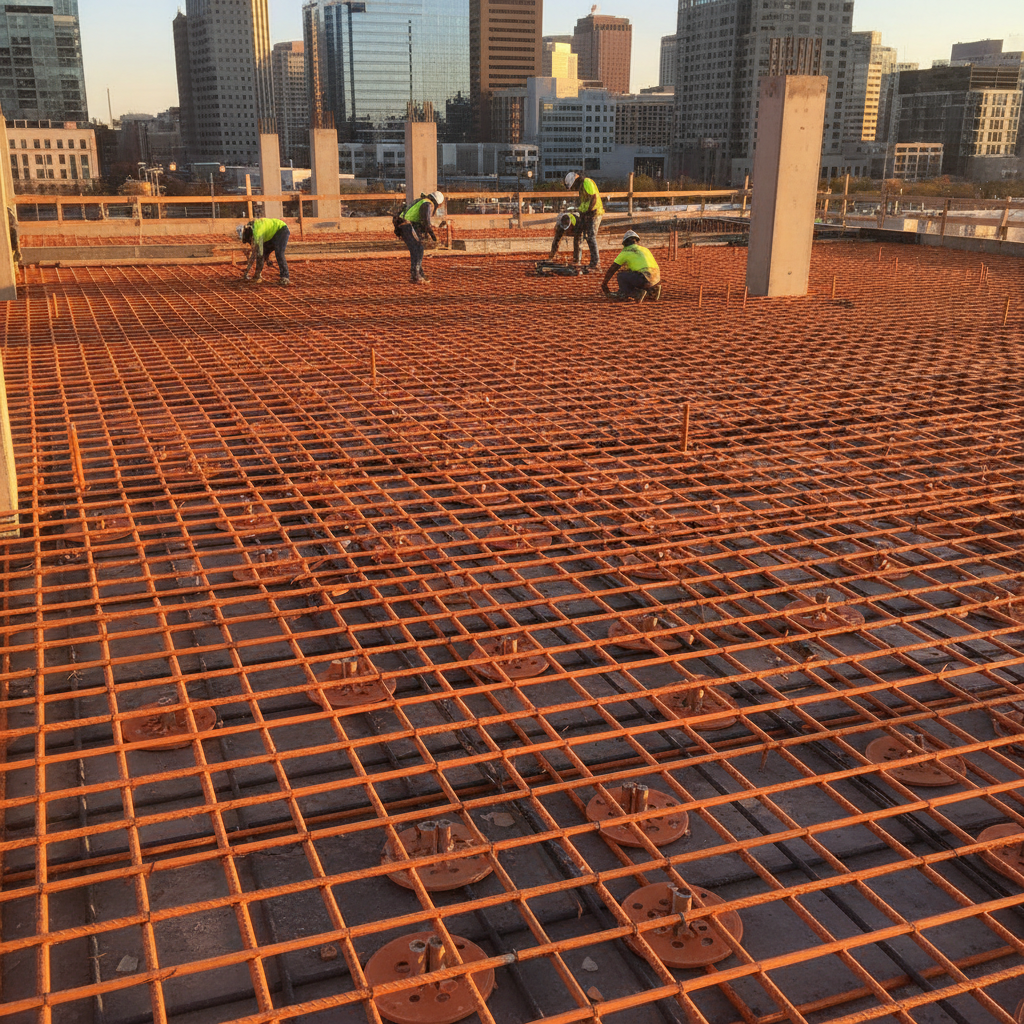
- Full-GFRP slabs and decks: Parking structures, bridge decks, and podium slabs in deicing zones.
- Hybrid reinforcement: GFRP in top mats; conventional or epoxy-coated steel in bottom mats to tune stiffness and crack control.
- Localized GFRP: Splash zones, barrier walls, joint regions, parapets, and edges most vulnerable to chlorides.
Bar types and accessories
- Straight bars with sand coatings for bond; diameters coordinated with available chairs and lap tables.
- Bent bars and stirrups with manufacturer radius limits; specify early to align with detailing requirements.
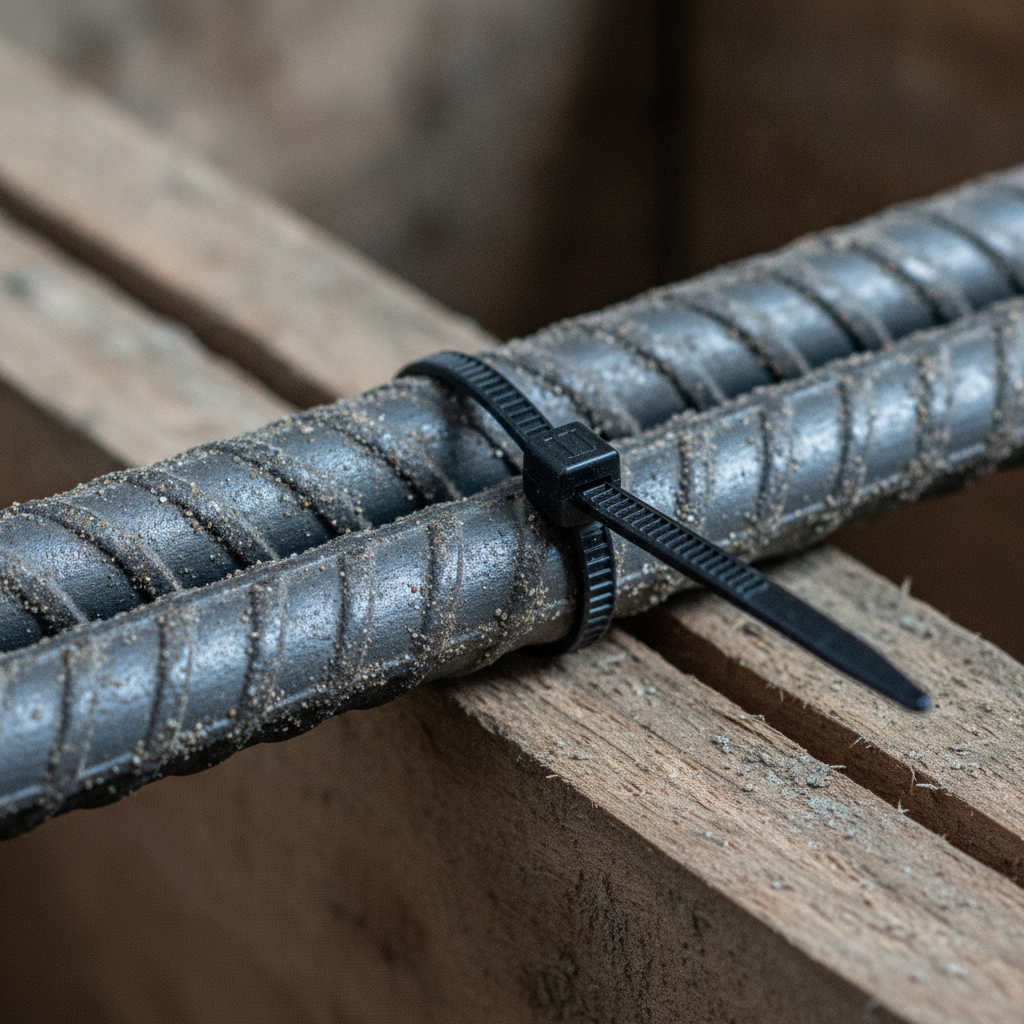
- Non-metallic hardware: Plastic ties, chairs, isolators, and spacers maintain electrical neutrality and avoid galvanic issues.
Where epoxy-coated steel still shines
- High-stiffness demand: When deflection control drives the design and depth is tight, steels higher modulus can help.
- Anchorage-intensive nodes: Congested 3D nodes with short development room often suit steel hooks and heads.
- Fire-rated members: Coordinate early with the EOR; protection strategies may steer the choice.
To compare options across a few core properties, use the quick reference below.
| Property | GFRP Rebar | Epoxy-Coated Steel | Black Steel |
|---|---|---|---|
| Corrosion resistance | Excellent (non-corrosive) | Good (coating dependent) | Poor in chloride exposure |
| Tensile behavior | Linear-elastic to rupture | Yield then strain harden | Yield then strain harden |
| Modulus (stiffness) | Lower (~68 Msi typical) | High (~29 Msi) | High (~29 Msi) |
| Weight | ~25% of steel | 100% baseline | 100% baseline |
| Magnetic/Conductive | Non-magnetic / low | Magnetic / conductive | Magnetic / conductive |
| Lifecycle in deicing salts | Long life; no rust | Improved vs black steel | Shorter; corrosion risk |
Best Practices: Design, Detailing, and Installation
Successful GFRP projects start with FRP-aware design, precise shop drawings, and jobsite discipline: non-metallic chairs, correct laps, protected bends, and careful handling. Pre-pour checklists, clear bar marks, and staged deliveries prevent RFIs and rework.
Design and engineering
- Confirm exposure class, target service life, and deflection limits early. This informs GFRP-only vs hybrid strategies.
- Size bars and spacing for stiffness; control crack widths via spacing adjustments rather than relying on yield.
- Plan anchorage: bend radius limits, lap lengths, or proprietary anchors. Avoid tight hooked congestion unless validated.
Detailing and shop drawings
- Call out non-metallic chairs, plastic ties, and spacers on drawings; include typical details near openings and edges.
- Use clear bar marks, mat identifiers, and lap tables specific to GFRP.
- Coordinate with fabrication on bend radii and pre-assembled mats to cut field labor.
Field installation
- Handle bundles with spreader bars and soft slings; avoid point loads that could nick coatings.
- Use plastic chairs at the specified spacing; confirm cover with a pre-pour walk.
- Stagger laps and respect lap lengths; dont substitute without the EORs approval.
- Keep torches, welders, and grinders off FRP zones; hot work requires protection barriers.
Quality control and inspection
- Measure chair spacing and cover; check that non-metallic accessories match submittals.
- Confirm bar IDs against the shop list before concrete arrives.
- Document pre-pour photos for traceability and owner confidence.
Our team often pairs these steps with staged delivery windows. With lighter loads and a coordinated just-in-time sequence, crews stay focused on ties and spacingnot chasing missing bars.
Tools and Resources (Ontario + Jobsite Ready)
Use coordinated estimating, FRP-aware detailing, and pre-assembled mats to accelerate schedules. Dass Rebar supports takeoffs, shop drawings, fabrication, trucking, and on-site assemblya single partner approach that reduces RFIs and delivery gaps.
Heres a practical toolkit we deploy with Woodbridge and GTA contractors:
- In-house estimating: Accurate takeoffs reduce change orders and help sequence mats. Our estimators flag FRP-specific laps and accessories early.
- In-house detailing: FRP spacing, lap tables, non-metallic accessories, and bend radii make it onto drawings you can build from.
- Fabrication: Pre-assembled GFRP mats, cut-to-length bars, and labeled bundles speed placement and reduce field cutting.
- Dedicated trucking fleet: Predictable delivery slots aligned with pour windows limit site congestion.
- On-site assembly: Our crews assist with layout, chairs, and laps to keep inspections smooth.
Need a steel comparison for hybrid designs or alternative scopes? This allied overview of structural framing provides additional context for mixed-material strategies in podiums and envelopes. See the structural framing guide for broader envelope thinking.
Get a coordinated FRP plan. Share your intent (top mat only, hybrid, or full GFRP) and pour windows. Well return a material list, accessory schedule, and delivery plan you can hand to the superintendent.
Case Studies and Examples (Scenarios)
Parking decks, podium slabs, bridge barriers, seawalls, and water treatment structures gain the most from GFRP. Real-world workflows pair FRP top mats with steel bottom mats or use full-FRP cages in harsh exposure zones to extend service life without slowing schedules.
Scenario 1: Podium slab in a mixed-use development
A developer plans a podium slab over retail with winter exposure from deicing runoff. The engineer selects GFRP top mats and steel bottom mats to balance stiffness and durability. Our detailing marks plastic chairs, lap zones, and penetrations. With pre-assembled mats and sequenced drops, the crew ties off faster than the previous steel-only pours.
- Outcome: Fewer RFIs, predictable inspection, and reduced long-term spall risk.
- What helped: Pre-assembled mats and fabrication sequencing.
Scenario 2: Parking structure exposure deck
Top decks see brine and thermal swings. Full-GFRP reinforcement in the deck and parapets limits chloride damage. We stage deliveries near Woodbridges arterial routes and coordinate crane picks to avoid rush windows around Queen St / Highway 50.
- Outcome: Faster placement per crane hour and no metallic hardware at the surface.
- What helped: Light bundles, clear bar marks, and a supply plan tied to the pour map.
Scenario 3: Water-side retaining and splash zones
For retaining walls and splash-prone edges, localized GFRP zones eliminate rust at the most vulnerable interfaces. Our shop drawings show transition details back to steel with proper laps and chairs.
- Outcome: Targeted durability where it matters while preserving stiffness in the main body.
- What helped: Non-metallic accessories, isolation details, and material choice planning.
Frequently Asked Questions
Most GFRP questions center on when to use it, how to design laps and spacing, and how it compares to epoxy-coated steel. The short answers: target chloride exposure zones, follow FRP tables, and choose hybrid layouts where stiffness demands are high.
Where should I use GFRP instead of steel?
Use GFRP in chloride or moisture exposure zones such as parking decks, bridge barriers, podium edges, seawalls, and treatment structures. Many teams also choose FRP for non-magnetic or low-conductivity requirements near hospitals, labs, and energy facilities.
Can I mix GFRP and steel in one member?
Yes. Hybrid designs are common: use GFRP in top mats where corrosion risk is highest and steel in bottom mats for stiffness. Coordinate lap transitions, cover, and inspection notes on the shop drawings before fabrication.
How is GFRP handled and tied on site?
Lift with spreader bars and soft slings, avoid point loads, and use plastic chairs and ties. Confirm cover during pre-pour walks. Keep torches and grinders away from FRP zones. Document placement with photos for inspection.
Is GFRP always better than epoxy-coated steel?
Not always. GFRP wins on corrosion resistance and weight, but steel offers higher stiffness and familiar anchorage in congested nodes. Many projects use a hybrid approach to balance durability and deflection control.
Do I need special chairs and accessories with GFRP?
Yes. Use non-metallic chairs, ties, isolators, and spacers. Call them out on drawings and verify submittals before the first pour. This avoids galvanic issues and preserves the non-conductive performance.
Conclusion and Key Takeaways
GFRP construction delivers non-corrosive strength that speeds placement and extends service life in harsh exposures. When paired with FRP-aware design, precise detailing, and coordinated logistics, it reduces RFIs and future repairs while keeping schedules steady.
- Target the right zones: Decks, splash edges, parapets, and seawalls benefit most.
- Design for stiffness: Control crack widths and deflection with spacing and depth.
- Detail the accessories: Non-metallic chairs, ties, and isolators are not optional.
- Stage deliveries: Lighter bundles and sequenced drops keep crews productive.
- Leverage a single partner: Estimating, detailing, fabrication, delivery, and assembly under one roof reduces friction.
Ready to plan your next FRP pour in Woodbridge? Share drawings and pour windows. Our team will return marked-up details, a material list, and a delivery plan aligned to inspections and concrete trucks.
Where to go next
Explore reinforcement choices and workflows that pair well with GFRP:
For steel alternatives and envelope coordination, see this steel frame houses guide. If youre scoping light-gauge or podium framing alongside your decks, the structural framing overview adds useful context. For adjacent residential scopes, this basement framing guide offers trade-aligned planning tips.