
Rebar estimating services are the professional quantification and bar-list planning that convert structural drawings into fabrication-ready data. For teams around 370 New Enterprise Way in Woodbridge, ON, accurate rebar estimating services keep bids sharp, reduce waste, and align delivery to pour breaks so crews place steel on schedule—without surprises.
By Navjot Dass • Last updated: May 22, 2026
Above the Fold: Overview & TOC
This complete guide shows how rebar estimating works end to end—what deliverables to expect, where waste hides, and how to link takeoffs to detailing, fabrication, trucking, and on-site assembly. You’ll learn practical steps you can apply immediately to bid smarter and pour on time.
- Quick Summary
- What Is Rebar Estimating?
- Why Accurate Rebar Estimating Services Matter
- How Professional Estimating Works
- Types, Methods, and Approaches
- Best Practices That Protect Your Schedule
- Tools and Resources
- Case Studies and Examples
- Pricing Factors (No Numbers)
- Choosing a Partner in Woodbridge
- Process At a Glance
- Frequently Asked Questions
- Key Takeaways
- Conclusion & Next Steps
- Related Articles & Next Reads
Summary
Professional rebar estimating translates drawings into bar lists, bend schedules, and placement summaries you can actually build from. When estimating is integrated with detailing, fabrication, and rebar delivery, schedules tighten, RFIs drop, and crews place the right steel at the right time.
In our experience supporting Ontario projects, the best results come from treating the estimate as a control plan that drives shop outputs and site logistics. That means one consistent set of quantities, tags, and pour sequences flowing from takeoff to trucks.
What Is Rebar Estimating?
Rebar estimating is a structured quantity takeoff that converts design intent into precise bar lists, bend details, and pour-by-pour staging notes. It’s the baseline for accurate bids, efficient fabrication, and predictable field placements.
At Dass Rebar, estimating is done in-house and aligned with detailing and shop workflows. That alignment reduces retyping, prevents interpretation gaps, and lets our trucking fleet stage deliveries to pour windows across the GTA and Ontario.
- Primary outputs: bar list, bend schedule, shape codes, placement summaries by pour/zone, and an assumptions log.
- Drawing inputs: structural plans, sections, schedules, typicals, and general notes.
- Material scope: Grade 500W and 400W, epoxy-coated where specified, Glass Fibre Reinforcing Bars (GFRB), and welded wire mesh.
- Format: spreadsheets and shop-ready exports that flow into fabrication cutting and bending.
Need a deeper primer? See our detailed rebar estimating guide for definitions, examples, and how we coordinate estimates with delivery staging.
Why Accurate Rebar Estimating Services Matter
Accurate rebar estimating services protect margins, schedules, and compliance. They reduce RFIs, prevent on-site shortages, and ensure fabricators cut what crews actually need—so every truck shows up aligned to the pour plan.
Here’s the thing: small quantity errors compound. They turn into rework, delayed pours, and congested laydown. When estimating, detailing, and logistics speak the same language, you avoid those bottlenecks.
- Bid precision: confidence in tonnage and shapes strengthens win rates without risky contingencies.
- Waste control: optimized cut patterns and lap planning lower scrap and handling.
- Schedule reliability: pour-by-pour tagging and bundles keep crews moving.
- Compliance: MTO familiarity and clear cover/lap notes ease inspections.
We connect estimating directly to shop outputs and trucking. That linkage turns your estimate into daily action—fewer phone calls, fewer yard runs, steadier placements.
How Professional Estimating Works
A repeatable workflow—scope intake, drawing review, takeoff, QA, and shop-ready handoff—keeps estimates clean and auditable. When the same team details and fabricates, the handoff is seamless and deliveries align to pour breaks.
- Scope intake: confirm unit system (metric for 10M/15M/20M), alternates (epoxy, GFRB), and key dates.
- Drawing review: lock cover, splice classes, and exposure notes; flag unclear typicals.
- Element takeoff: footings, walls, slabs, beams, columns, cores, stairs—each on dedicated tabs.
- Assumptions: maintain a rolling log to reduce later RFIs.
- Bar list & bends: shape codes, cut lengths, hooks, laps, and pour/zone tags.
- QA checks: second-person review of math, laps, and drawing cross-references.
- Handoff: exports feed cutting and bending with no retyping; trucks scheduled to pour windows.
For context, Ontario’s 10M, 15M, and 20M nominal diameters align closely to #4, #5, and #6 in the U.S. That impacts bar spacing, laps, and tie rates—and therefore fabrication and install productivity.
To understand how this feeds downstream, review our rebar detailing guide and how shop drawings translate takeoffs into shop and site clarity. For supply planning, our rebar supply guide outlines stock options like welded wire mesh (6″x6″x 6/6, 9/9, 10/10).

Types, Methods, and Approaches
Different projects call for different estimating approaches. Small jobs benefit from streamlined spreadsheets; high-rises and infrastructure benefit from model-linked takeoffs with pour sequencing and automated change tracking.
Common estimate types
- Conceptual tonnage: early planning ranges to test phasing and logistics.
- Pre-bid detailed takeoff: itemized bar lists and bends for competitive bids.
- Fabrication-ready summary: sequenced lists aligned to shop cutting patterns.
- Change-order deltas: quantified adds/credits with revised staging plans.
Approach comparison
| Approach | Speed | Accuracy | Change handling | Best for |
|---|---|---|---|---|
| Manual takeoff | Moderate | Good with strong QA | Manual updates | Simple elements |
| Spreadsheet system | Faster with templates | Good to very good | Tracked by versions | Small to mid jobs |
| Software-integrated | Fastest on volume | High with model links | Automated diffs | High-rise & infra |
| Full-service provider | Fast & coordinated | High, multi-check | Linked to shop + trucks | Schedule-critical work |
For a cross-trade explainer on how disciplined takeoffs improve outcomes, this framing-focused overview shows parallels in scope control and assumptions logging seen in rebar work as well (estimating in framing).
Best Practices That Protect Your Schedule
The most reliable estimates pair quantity precision with logistics discipline. Fix your unit system, standardize lap assumptions, tag bundles to pours, and align cut patterns to reduce drops. Then stage deliveries to pour calendars so crews stay productive.
Standards and assumptions
- Unit system locked: state metric/imperial and conversion notes on page one.
- Lap and cover rules: splice classes, hooks, epoxy, and GFRB handling spelled out.
- Exposure notes: identify epoxy-coated areas and inspection checkpoints.
Deliverables that crews love
- Pour-tagged bundles: labels tie directly to placement drawings and zones.
- Optimized cutting: shop patterns tuned to bar stock lengths to limit scrap.
- Sequenced truck lists: deliveries arrive in the order crews install.
We document every assumption in a living log and push that into detailing and fabrication. Learn how those drawings communicate on site in our shop drawings overview.
Tools and Resources
Reliable estimating tools include consistent spreadsheet templates, checked formulas, a standards library, and clean exports straight into shop cutting and bending. The goal is simple: no retyping, no interpretation gaps, no surprises.
Core toolkit
- Templates: element tabs for footings, walls, slabs, beams, columns, cores, and stairs.
- Standards pack: lap charts, hook tables, cover minimums, epoxy/GFRB notes.
- Exports: CSV or platform outputs wired to fabrication workflows.
- Schedule link: pour calendars mapped to dispatch windows and site access.
Helpful references
- If your team is maturing its project controls, a quick overview of delivery frameworks can help align estimating with field execution (project methodologies snapshot).
- For teams building repeatable estimating habits, a short primer on scoping and checklists can be useful context even outside rebar (PM software tips).
Coordinating materials? Our note on delivery windows lays out how timing affects crew flow and crane access in the GTA—see timely rebar delivery practices.
Case Studies and Examples
Integrated estimating shortens schedules by turning one bar list into shop outputs and truck lists. Ontario project teams report cleaner staging, fewer yard runs, and smoother inspections when estimates drive detailing, fabrication, and delivery.
High-rise residential core
- Need: consistent cycles across core walls and slabs using 10M, 15M, and 20M mixes.
- Action: pour-tagged lists flowed to shop cutting; daily trucks mirrored pour zones.
- Result: steadier placements and less laydown congestion.
Municipal structure (MTO familiarity)
- Need: exposure-driven epoxy use, documented laps and covers, welded wire mesh in slabs.
- Action: estimator–detailer QA routine; epoxy-coded bundles staged by inspection sequence.
- Result: inspection-ready placements and clear field documentation.
Commercial podium
- Need: clash-aware beam/column cages and tight deck cycles.
- Action: shape optimization plus staged mesh and bar deliveries.
- Result: reduced rework and smoother deck turnovers.
For more on how fabrication decisions support these outcomes, review our rebar fabrication guide.
Pricing Factors (No Numbers)
Estimating proposals reflect scope size, complexity, standards, and integration depth. Quotes consider drawing completeness, alternates (epoxy, GFRB), timeline, and whether deliverables feed directly into shop cutting, bending, and delivery staging.
- Scope size: number of sheets, elements, alternates, and clarifications.
- Complexity: congested reinforcement, heavy bends, seismic or exposure details.
- Standards: epoxy-coated, GFRB, welded wire mesh, inspection notes.
- Integration: how cleanly exports feed fabrication and trucking.
- Schedule: milestone alignment, crew windows, and pour cadence.
Value rises when the estimate becomes the single source for shop and site. That’s where fewer handoffs and predictable deliveries pay off.
Choosing a Partner in Woodbridge
Select a provider that estimates, details, fabricates, delivers, and assembles under one roof. Ontario familiarity with metric sizes (10M/15M/20M), MTO standards, and a dedicated trucking fleet reduce risk and keep crews productive.
- Ontario expertise: comfort with MTO-approved specifications and inspection norms.
- In-house stack: estimating, detailing, project management, fabrication, delivery, and assembly.
- Fleet alignment: trucks mapped to pour tags, site access, and crane availability.
- Material breadth: Grade 500W/400W, epoxy-coated rebar, GFRB, and welded wire mesh.
- Proven projects: residential, commercial, and infrastructure experience across Ontario.
Local considerations for 370 New Enterprise Way
- Plan winter pours with heated enclosures and earlier dispatch times; shorter daylight affects crew pacing.
- Account for seasonal road restrictions; adjust loads or trips to preserve the pour calendar.
- Coordinate around GTA rush periods; early call-ins secure crane time and reduce staging bottlenecks.
To see how these choices show up on paper, compare against our field-focused rebar drawings explainer.
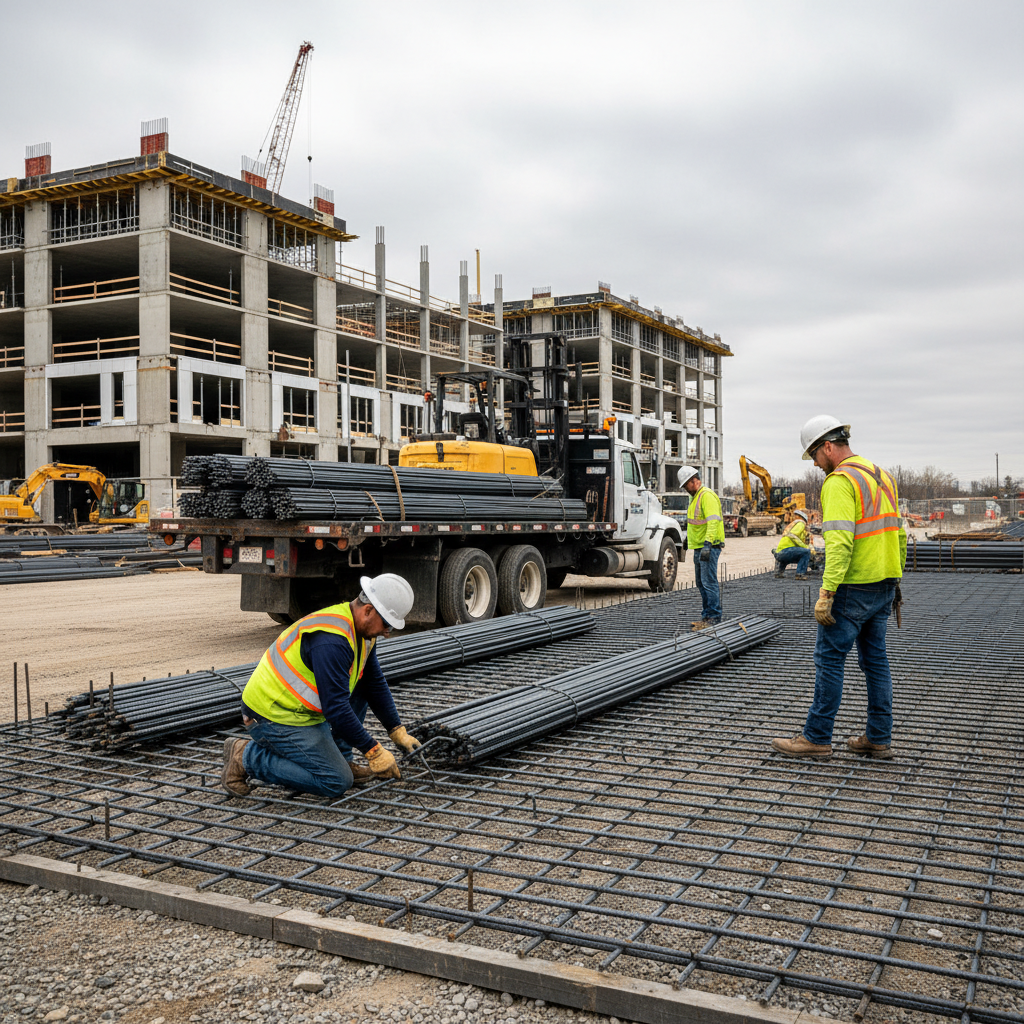
Process At a Glance
A clear process turns drawings into buildable deliverables. Intake, review, takeoff, QA, and handoff to shop and trucks keep estimates aligned with schedules from day one.
| Step | What you see | Why it matters |
|---|---|---|
| Intake | Scope sheet, assumptions log | Locks unit system and laps |
| Takeoff | Element tabs and counts | Builds the bar list backbone |
| QA | Second-person checks | Catches math and lap errors |
| Handoff | Shop-ready exports | Eliminates retyping risk |
| Staging | Pour-tagged bundles | Speeds daily placements |
Frequently Asked Questions
These quick answers clarify what you’ll receive and how estimating connects to detailing, fabrication, and delivery. Share them with your field and office teams.
What deliverables come with a professional rebar estimate?
Expect a bar list by element, a bend schedule with shape codes, placement summaries by pour or zone, and an assumptions log. Many teams also provide shop-ready exports so fabrication mirrors the estimate without retyping.
How do rebar estimating services reduce waste?
Optimized cut patterns, standardized lap assumptions, and pour-tagged bundles reduce scrap and handling. When estimates connect to shop cutting and delivery staging, crews receive precise bars on time, avoiding over-ordering and site damage.
Can estimates include epoxy-coated or GFRB alternates?
Yes. Estimates can show epoxy-coated and glass fiber reinforcing bar (GFRB) options where exposure or corrosion resistance is required. The estimator applies the correct cover, splice, and handling notes for each material.
What’s the difference between estimating and detailing?
Estimating quantifies materials from design drawings for bids and planning. Detailing turns those quantities into shop drawings and exact shapes for fabrication and placement. When both are in-house, the handoff is faster and errors drop.
Key Takeaways
Treat the estimate as a control plan tied to shop and site. When one bar list drives cutting, trucking, and placements, schedules stabilize and waste falls.
- Integrate the stack: estimating, detailing, fabrication, delivery, and assembly under one roof.
- Standardize assumptions: unit system, laps, covers, epoxy/GFRB rules.
- Tag to pours: bundle labels and truck lists in the order crews install.
- Close the loop: exports feed shop machines without retyping.
Conclusion & Next Steps
Use rebar estimating services to align your bid, shop plan, and delivery schedule. The result is steadier placements, cleaner inspections, and fewer last-minute scrambles.
- Share your drawings and milestones—get a scoped estimate with pour-tagged outputs.
- Decide on epoxy or GFRB exposure areas early and log assumptions.
- Sync truck windows to your pour calendar and site access constraints.
Ready to connect estimating to fabrication and delivery? Our coordinated approach supports residential, commercial, and infrastructure projects across Ontario—anchored from Woodbridge. Let’s plan your next pour sequence.
Related Articles & Next Reads
Explore connected topics that turn your estimate into action: how shop drawings clarify placements, how fabrication choices cut waste, and how timed deliveries keep pours on track.
If you found this guide useful, continue with deep dives on shop drawings, fabrication methods, supply planning, and delivery timing—all aligned with Ontario’s metric standards and MTO expectations.