
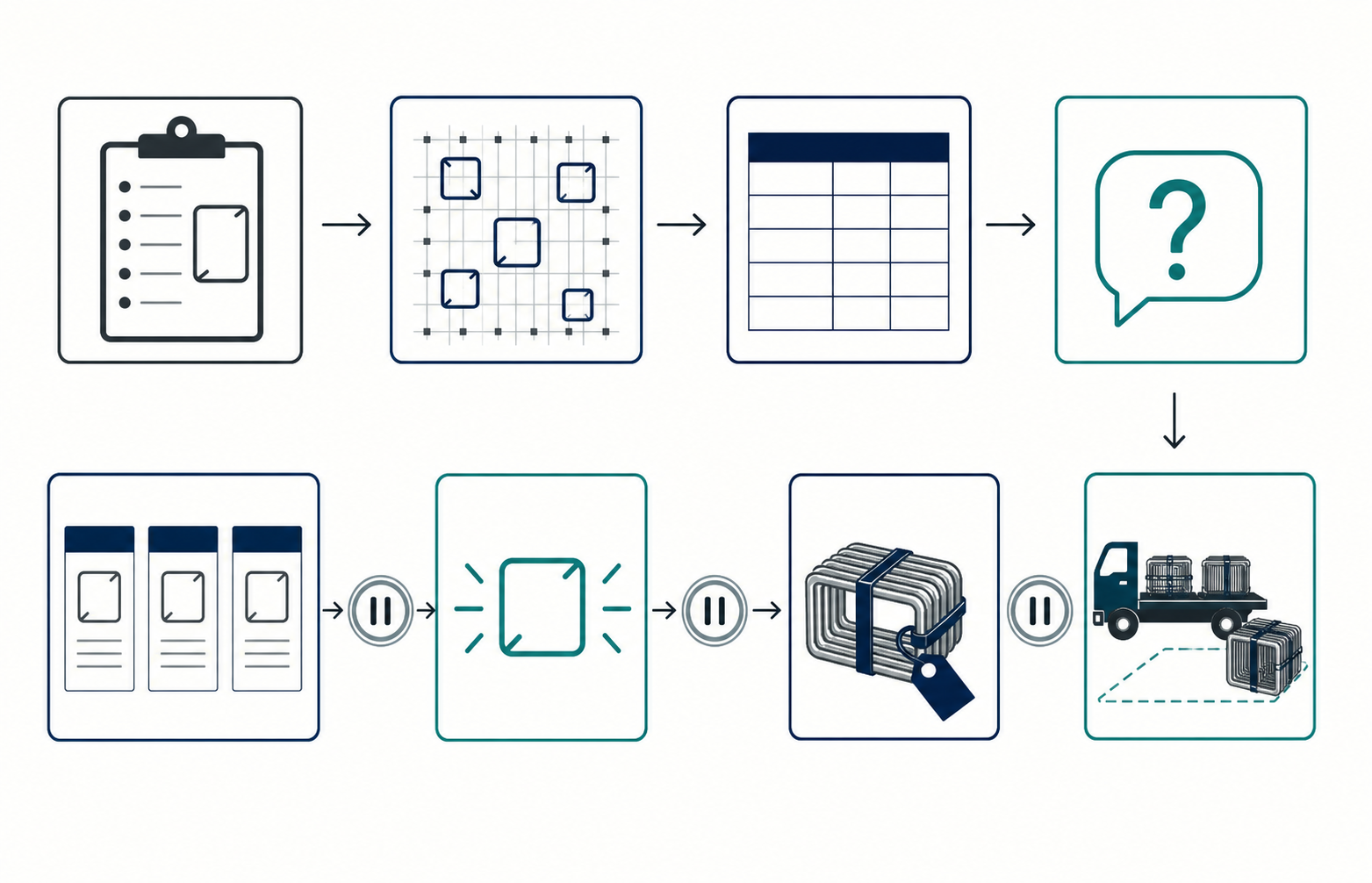
Steel stirrups look simple because each piece is compact, but an order can contain many shape, dimension, material, hook, quantity and sequencing decisions. The structural design and approved placing information control those decisions. A buyer’s job is to convert the current documents into a traceable fabrication request—not to redesign the reinforcement from a generic catalogue.
CRSI defines stirrups as reinforcing bars or welded wire reinforcement used in beams and girders for shear reinforcement, commonly bent into U or box shapes and placed perpendicular to longitudinal bars. That definition explains their role; it does not select a stirrup for a particular member.
 212-8778b.png)
Use project criteria rather than a generic stirrup size
The engineer’s structural drawings establish reinforcement requirements. Placing drawings and bar lists translate those requirements into fabrication and field information. CRSI notes that a beam schedule can include the quantity, size, length and mark numbers of reinforcing bars and stirrups, including spacing where specified.
| Selection field | What the buyer should provide | What not to infer |
|---|---|---|
| Bar mark | Unique approved identifier | Similar-looking shapes are interchangeable |
| Material | Specified bar designation, grade and coating | The fabricator’s stock is automatically acceptable |
| Shape | Referenced bend shape or fully dimensioned sketch | “Closed stirrup” defines every hook and leg |
| Dimensions | Values and measurement convention from approved documents | Outside, inside and centreline dimensions are equivalent |
| Quantity | Count by mark, zone and release | Spacing alone gives the final order quantity |
| Sequence | Required bundle, level and placement order | One bulk delivery fits site operations |
If any field is missing or contradictory, issue a request for information through the project process. Do not resolve a structural discrepancy through a purchasing email or a verbal assumption.
Control revisions before fabrication release
Identify the structural drawing, specification, placing drawing, schedule, approved submittal and revision that govern each bar mark. Stamp or otherwise record which marks are released, held or superseded. A design change can affect shape, quantity, spacing, lap, cover, congestion and the construction sequence.
- Build a register of drawings, specifications and addenda.
- Map each requested bar mark to the controlling detail and revision.
- Record unresolved discrepancies and responsible reviewer.
- Release only marks with complete dimensions and approval status.
- Transmit revisions with a change summary and cancelled-mark list.
- Obtain acknowledgement before fabrication continues.
Keep engineering review separate from detailing and fabrication responsibilities. A placing drawing organizes information for construction, but it does not authorize an unapproved design change.
Describe bend shape and measurement convention completely
Two stirrups can share an overall appearance while differing in hook angle, extension, leg dimension, bend diameter or measuring point. Provide the recognized shape reference used by the project or a complete dimensioned diagram. State whether dimensions are measured inside, outside or to bar centreline where the governing practice requires that distinction.
Ask the fabricator to identify any shape that cannot be produced as drawn under the specified material and fabrication requirements. Resolve that issue with the detailer and responsible designer before substituting a hook, bend or bar.
Confirm material, coating and traceability
The order should repeat the project’s specified reinforcing-bar standard, grade and coating without translating them into a supplier preference. Ask what mill documentation, coating records or certificates are required and how they will be linked to bundles. Do not claim a certificate proves project compliance until the responsible reviewer checks the actual document and scope.
Coated reinforcement may require particular handling, repair and storage procedures. Stainless, galvanized, epoxy-coated or other reinforcement cannot be substituted based only on a general corrosion claim. Confirm compatibility, bend requirements, repair procedures and acceptance through the project specification and design review.
| Buying question | Acceptable evidence | Red flag |
|---|---|---|
| What material will be used? | Written designation matching the order | “Equivalent” without a documented review |
| How are bars traced? | Bundle tags and linked records | Loose pieces with no mark identity |
| How are bends checked? | Defined fabrication and inspection process | Field rebending proposed as routine correction |
| How is coating handled? | Project-specific handling and repair procedure | No answer for damage or cut ends |
| What is excluded? | Written list of detailing, engineering, freight and site work | A low total with unclear scope |
Compare fabricators on the same release package
Send the same current documents to each bidder and set a clarification deadline. Compare acknowledgment of revisions, included marks and quantities, material, coating, documentation, fabrication scope, freight, delivery sequence, taxes, packaging, lead-time basis and change terms. A unit rate cannot be compared fairly if one quote includes detailing and delivery while another excludes them.
Ask how the fabricator handles incomplete dimensions, revised marks, cancelled pieces, urgent releases and nonconforming material. The answer should describe a controlled process, not promise that every issue can be fixed in the field.
Plan bar marks, bundles and site receipt
Bundles should support the placement sequence and remain identifiable. Define tag content, maximum practical bundle constraints, unloading responsibility, delivery windows and laydown zones with the contractor and supplier. Weather, traffic and site access can change delivery logistics; they do not change the approved bar requirements.
At receipt, compare tags and counts with the shipping record and current bar list. Quarantine pieces with missing identity, visible damage, unexpected coating condition or dimensions that appear inconsistent. Record the issue and follow the project’s nonconformance process rather than modifying the bar without authorization.
- Verify truck, release and drawing revision.
- Match every bundle tag to the bar list.
- Check count and obvious condition without removing identity.
- Store bundles to preserve tags and specified condition.
- Escalate discrepancies before placement.
- Retain delivery, inspection and resolution records.
Steel stirrup buying red flags and common mistakes
- Ordering by a verbal size: use approved marks and fully controlled documents.
- Missing measurement convention: inside, outside and centreline dimensions can differ.
- Assuming standard hooks: the project detail and governing requirements control.
- Accepting undocumented equivalence: route substitutions to the responsible reviewer.
- Mixing revisions: cancel superseded marks and obtain acknowledgment.
- Ignoring bundle sequence: a correct piece can still arrive in an unusable order.
- Losing traceability: tags and records should follow material to receipt.
- Planning field fixes: cutting, rebending or welding requires specific authorization and procedure.
Frequently asked questions
Are all steel stirrups rectangular?
No. CRSI notes common U and box forms, but actual shape and hooks come from the project documents. Do not generalize from a catalogue image.
Can a fabricator change a hook to simplify production?
Not without the project’s required review and authorization. A fabrication convenience cannot replace structural approval.
Is the lowest per-piece price the best quote?
Not necessarily. Compare material, documentation, detailing, packaging, freight, sequencing, revisions and exclusions on the same basis.
What should happen when a bundle tag is missing?
Preserve and quarantine the material, document the issue and follow the project’s traceability and nonconformance process before placement.
Send a controlled stirrup request for quote
Issue a mark-by-mark schedule with current drawings, material, shape, dimensions, quantity, approval status and delivery sequence. Ask bidders to identify every exception instead of filling gaps silently.
Sources reviewed
- Dass Rebar fabrication page — first-party fabrication and quote-route context only.
- Dass Rebar services page — first-party service categories; no project outcome inferred.
- CRSI reinforcing terminology — stirrup, beam schedule and placing-drawing definitions.
- CRSI reinforcing-bar placing — placing drawing, support and field context.