
Epoxy coated steel rebar is carbon-steel reinforcement wrapped in a fusion-bonded epoxy barrier that blocks chloride and moisture, slowing corrosion and extending concrete service life. For projects around 370 New Enterprise Way in Woodbridge, ON, Dass Rebar supplies epoxy-coated options with in-house estimating, detailing, fabrication, delivery, and on-site assembly.
By Navjot Dass — Dass Rebar
Last updated: May 9, 2026
Summary
Epoxy-coated rebar (ECR) protects steel from salt-driven corrosion, delivering longer service life for bridges, garages, and podium slabs. This guide explains what ECR is, where it excels, how to specify and handle it, and how Dass Rebar supports Ontario builders with estimating, detailing, fabrication, logistics, and compliant materials.
Use this complete, practical guide to move from concept to pour with fewer surprises:
- Understand what epoxy-coated rebar is and how the coating works
- Decide when to choose ECR versus black bar, galvanized, stainless, or GFRP
- Follow a step-by-step path from takeoff to installation and inspection
- Apply best practices for handling, splicing, tying, and field repairs
- Tap tools, checklists, and Ontario-focused examples from Dass Rebar
What Is Epoxy Coated Steel Rebar?
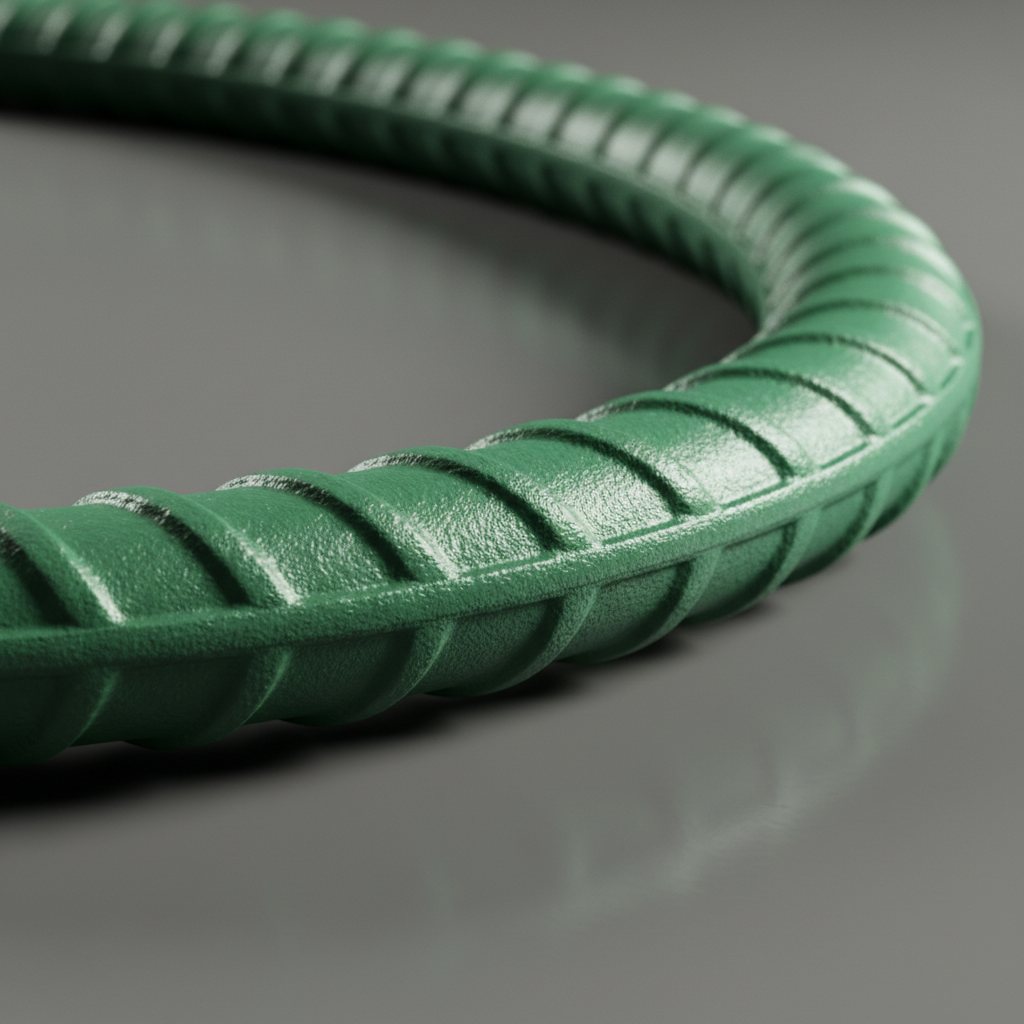
Epoxy-coated steel rebar (ECR) is conventional carbon-steel reinforcement factory-coated with a thin, dielectric epoxy layer. The coating isolates steel from chlorides and oxygen, delaying corrosion initiation in concrete exposed to deicing salts and marine spray, while maintaining familiar bar strengths, sizes, and installation practices.
At its core, ECR is standard reinforcing steel with an added, bonded epoxy film—often recognizable by its green color—that acts like a raincoat for the bar. The barrier reduces the rate at which chloride ions reach the steel surface, which slows rusting and preserves bond and cross-section over time.
Key characteristics you can rely on
- Fusion-bonded epoxy (FBE) encapsulates the ribs and bends to form a continuous barrier.
- Compatible with standard mixes: No special concrete is required; cover and curing still matter.
- Recognizable in the field: Color-coded coating supports quick inspection and verification.
- Ontario-ready sizes: Common 10M, 15M, and 20M bars are readily available through Dass Rebar.
In our experience supporting Ontario bridge decks and podium slabs, ECR is the practical, code-aligned durability upgrade when you need extra protection without changing reinforced concrete fundamentals.
Why Epoxy-Coated Rebar Matters for Ontario Projects
Epoxy-coated rebar reduces chloride-induced corrosion, which is the leading durability risk where deicing salts are used. For bridge decks, ramps, and garages, ECR helps preserve steel cross-section, maintain bond, and extend structural life—supporting fewer disruptive repairs and more predictable lifecycle planning.
Here’s the thing: winter maintenance keeps roads safe, but it also loads concrete with chlorides. Once enough chlorides reach bare steel, corrosion accelerates, cracks form, and spalls follow. ECR interrupts that process. The payoff is real in decks, podiums, ramps, and balcony edges that live in splash and spray zones.
- Longer service life: Slower corrosion growth means fewer early repairs and less downtime.
- Lifecycle value: Owners plan maintenance around usage, not premature deterioration.
- Operational continuity: Fewer closures for rehabilitation on high-traffic assets.
- Predictable builds: Bars install like familiar black steel—no exotic learning curve.
For contractors across the GTA, that translates to durable concrete with familiar workflows. Our teams coordinate estimating, detailing, fabrication, and rebar supply so your schedule stays intact.
How the Coating Works
The fusion-bonded epoxy forms a continuous, dielectric barrier around the rebar, limiting chloride and moisture contact with steel. With proper concrete cover, consolidation, and curing, this barrier delays corrosion initiation and reduces rust propagation, preserving bond and cross-section in aggressive environments.
Think of ECR as protection in layers: good concrete cover, low permeability through curing and mix design, and then the epoxy film itself. Even if small nicks occur, field repairs and robust concrete cover keep the system resilient.
What actually stops the rust?
- Dielectric isolation: The coating reduces the electrochemical pathway for corrosion.
- Barrier to chlorides: Slows ion diffusion to the steel surface.
- Crack management: Durable cover and mix reduce crack widths, further limiting ingress.
- Field repairability: Approved patch materials can restore small coating defects.
We’ve found that when cover, curing, and handling discipline line up, the coating’s performance is remarkably consistent on decks and parking structures that see winter salt every season.
Types, Alternatives, and Where Each Fits
Choose among black bar, epoxy-coated, galvanized, stainless, and GFRP based on exposure, durability targets, and budget. ECR offers a strong balance of protection and familiarity; galvanized improves barrier robustness; stainless maximizes corrosion resistance; GFRP removes corrosion risk but changes design and detailing.
There’s no one-size-fits-all solution. Your exposure conditions, target service life, and constructability drive the choice. Below is a high-level comparison we use in early design conversations.
| Rebar Type | Corrosion Resistance | Typical Uses | Field Notes |
|---|---|---|---|
| Black (uncoated) | Baseline | Interior slabs, low-chloride exposure | Most familiar; relies on cover and concrete quality |
| Epoxy-coated (ECR) | Enhanced vs. black | Decks, ramps, podiums, splash zones | Install like black; inspect coating; repair small nicks |
| Galvanized | High (zinc barrier) | Harsh splash/spray; abrasion concern areas | Rugged coating; check for dissimilar metal details |
| Stainless | Very high | Critical zones; long design lives | Excellent resistance; different procurement lead times |
| GFRP (glass fiber bars) | Non-corroding | Water treatment, MRI rooms, decks with high chloride | Different design assumptions and detailing rules |
When you want corrosion protection without changing reinforcing geometry or finishing workflows, ECR is often the sweet spot. For certain zones, we also detail hybrid solutions—ECR generally, stainless or GFRP in the most aggressive hot spots.
Specification, Submittals, and Ordering
Define bar sizes, grades, coating requirements, splice strategy, and handling in the spec. Then align shop drawings, bar lists, and logistics with your pour sequence. Dass Rebar supports this flow with in-house estimating, detailing, fabrication, and trucking to keep schedules tight and submittals clean.
Clear specs avoid downstream friction. Our team starts with your drawings and performance goals, then builds a coordinated path from takeoff to first delivery.
Your step-by-step path
- Define exposure and targets: Deck, ramp, podium, balcony edges, or marine-adjacent?
- Choose reinforcement strategy: ECR alone or hybrid with galvanized, stainless, or GFRP.
- Confirm grades and sizes: Ontario standards such as 10M, 15M, 20M; Grade 400W or 500W.
- Draft handling notes: Non-abrasive slings, coated tie wire, padded dunnage.
- Coordinate splices: Laps, mechanical couplers, and bar staggering per drawings.
- Detail shop drawings: Our in-house detailing team prepares compliant, clash-aware drawings.
- Fabricate and tag: Cutting, bending, bundling, and identification for field clarity.
- Stage deliveries: Sequence aligned to your pour breaks and crane picks.
Need a quick sizing sanity check? See our internal guide to 10M rebar uses for common residential and podium applications, or connect with our estimators for project-specific takeoffs.
Fabrication, Handling, and Installation Best Practices
Protect the coating from abrasion and cuts during fabrication, delivery, and placement. Use padded dunnage, nylon slings, coated tie wire, and non-abrasive spacers. Inspect bars for nicks, repair minor defects with approved patch materials, and reject severe damage to maintain long-term protection.
Most ECR issues trace back to poor handling, not the product. Small changes—like using nylon slings instead of chains—protect your investment.
Fabrication and yard controls
- Mandrel bends with discipline: Follow bend radii that avoid cracking the coating.
- Clean tools: Keep bending and cutting equipment free of burrs and debris.
- Tagging and bundling: Identify coated bars clearly to prevent mix-ups with black bar.
Delivery and site handling
- Padded contact points: Use timber with pads; avoid dragging bundles on concrete.
- Nylon or synthetic slings: Ditch chains and wire ropes that can gouge coating.
- Store off the ground: Keep bundles on dunnage; cover to reduce UV and contamination.
Placement and tying
- Coated tie wire: Maintain the barrier continuity at ties and chairs.
- Plastic or epoxy chairs/spacers: Prevent point damage from steel supports.
- Vibration awareness: Consolidate concrete properly to protect cover and bond.
We incorporate these controls in our fabrication practices and coordinate with supers so crews know exactly what matters before the first pick.
Quality Assurance, Inspection, and Field Repairs
Build a simple QA loop: inspect coating on receipt, after handling, and before pour. Mark nicks, clean the area, and apply approved patching material per instructions. Track repaired locations and recheck before placement so small defects don’t become big durability liabilities.
A quick field repair kit and checklist go a long way. Our project managers often stage kits by the deck pour so crews can react fast to incidental scuffs.
Three-part QA loop
- Receiving: Verify tags, sizes, coating condition, and storage setup.
- Pre-placement: Walk bundles as they’re opened; repair visible defects.
- Pre-pour: Final pass for laps, chairs, cover, and any fresh abrasions.
Repair essentials
- Surface prep: Lightly abrade around the nick; remove dust and contaminants.
- Apply patch: Use compatible epoxy patch per manufacturer guidance.
- Verify cure: Allow proper set time before tying or pouring concrete.
To keep momentum on tight GTA schedules, our supply coordination pairs QA checkpoints with your pour calendar, making rebar quality part of the rhythm rather than a roadblock.
Design Details: Splices, Couplers, and Cover
Plan lap splices and couplers early, keeping coating integrity and constructability in mind. Maintain specified cover with appropriate chairs and spacers. Where congestion is high, mechanical couplers reduce laps and minimize coating contact, easing placement and vibration.
Splice decisions drive congestion, finishing, and inspection effort. Early alignment across engineering, detailing, and field teams prevents late-game rework.
- Lap splices: Stagger where possible to avoid bulky zones and honeycombing risk.
- Mechanical couplers: Useful at joints and barriers; confirm compatibility with coated bars.
- Concrete cover: Use non-abrasive supports sized for the specified cover in decks and edges.
We reflect these choices on shop drawings and bar lists so field crews always see the intent. When decks include 10M distribution with 15M top steel, for example, couplers at barrier connections often simplify both placing and inspection.
Procurement and Logistics With Dass Rebar
Dass Rebar connects estimating, detailing, fabrication, and trucking into one coordinated flow. You get bar lists aligned to pour breaks, bundles sequenced for crane picks, and deliveries staged for lanes and access. That integration cuts friction and helps trades stay productive.
Because we keep these functions in-house, it’s easier to sync drawings, fabrication, and delivery windows. Fewer handoffs mean fewer surprises.
- In-house estimating: Fast takeoffs for design-assist or bid deadlines.
- In-house detailing: Clash-aware drawings and labeled bundles for clean installs.
- Fabrication: Cutting, bending, and tagging to spec with coated-handling discipline.
- Dedicated trucking: Predictable arrivals across the GTA and Ontario corridors.
- On-site assembly: Crews that know how to protect coating while maintaining speed.
On multifamily podium projects in Toronto, this sequencing is the difference between an orderly pour and a scramble. We build your logistics plan from the pour schedule backwards.
Ontario Case Examples and Scenarios
Epoxy-coated rebar helps decks and podiums endure winter salt and freeze–thaw. Across Ontario projects—like residential podium slabs and garage ramps—contractors use ECR to protect edges and splash zones while keeping familiar reinforcement practices and schedules intact.
We can’t publish every client detail, but these common Ontario scenarios mirror what we deliver daily:
- Podium slab over retail: 10M distribution with ECR top steel around openings; couplers at barrier posts to reduce laps and speed placement.
- Parking ramp transitions: ECR in splash lanes near drains; plastic chairs maintain cover despite heavy trades traffic.
- Bridge deck approaches: ECR mats prefabricated for lane closures; epoxy tie wire and padded delivery keep coating intact.
- Balcony edge beams: ECR perimeter bars and stirrups resist salt spray and air entrainment variability over time.
When working with contractors in Woodbridge and the GTA, we’ve found a hybrid approach—ECR generally and specialized reinforcement where needed—balances performance and constructability without complicating inspections.
Tools, Checklists, and Resources
Use simple checklists and field tools to protect coating integrity and schedule. Pair a receiving checklist with a repair kit, add handling notes to your pour plan, and keep a pre-pour verification sheet on clipboards. Small routines prevent delays and extend durability.
Downloadable-style checklists (use as-is)
- Receiving: Verify tags, sizes, coating condition, and padded storage.
- Handling: Nylon slings, no dragging, plastic chairs, coated tie wire.
- Repair kit: Abrasive pad, solvent wipe, approved patch, applicators, rags, gloves.
- Pre-pour: Check laps, couplers, cover, repaired spots, and congestion.
- Documentation: Note repaired areas and snap quick photos for the log.
Quick references from our network
For broader steel context and compatible products, explore our network resources:
- See reinforcing product context at Dass Metal rebar overview.
- Read about steel framing synergies in Why steel framing matters.
- Review fundamentals in how rebar strengthens concrete.
If you’re planning a complex deck, our team can turn these lists into project-specific submittal templates in a single coordination call.
Step-by-Step: From Takeoff to Pour
Plan exposure, choose reinforcement strategy, and confirm sizes. Then align shop drawings, fabrication, and deliveries to pour breaks. Protect coating during handling and placement, repair minor nicks, verify cover and splices, and document a final pre-pour check. This linear path keeps decks on schedule.
- Assess exposure: Identify splash zones, drains, and salt paths.
- Select reinforcement: ECR baseline, with targeted galvanized, stainless, or GFRP if needed.
- Lock sizes and grades: 10M/15M/20M patterns; Grade 400W or 500W per drawings.
- Coordinate detailing: Submit shop drawings reflecting splices, couplers, and chairs.
- Fabricate and stage: Bundle and tag for crane picks and pour sequences.
- Deliver with protection: Padded dunnage, nylon slings, covered storage off-grade.
- Place and tie: Use coated wire and plastic spacers; avoid abrasion.
- Repair and verify: Patch small nicks; measure cover; re-walk before pour.
- Document: Photo log repaired areas; record checks for closeout.
We align each step with your schedule, so rebar shows up sequenced and ready. That reduces crane time and keeps finishing crews moving.
Common Mistakes to Avoid
The biggest risks are coating damage, poor storage, and inadequate pre-pour checks. Avoid chains and dragging, store off the ground with covers, and stage a repair kit on site. Brief the crew on tying and chairs to protect coating and preserve concrete cover.
- Using chains or wire rope on picks that scar coating.
- Dragging bundles across slabs or formwork.
- Skipping pre-pour walks that would catch repairs, laps, or cover issues.
- Mixing coated and black bars after tags are removed; label clearly.
- Underestimating congestion where couplers or staggered laps would help.
These are simple to fix with a short toolbox talk and a one-page checklist taped in the gang box.
When Epoxy Isn’t the Only Answer
If exposure is extreme, abrasion is likely, or non-magnetic reinforcement is required, consider galvanized, stainless, or GFRP. Hybrid strategies often optimize performance: epoxy-coated bars broadly, with targeted stainless or GFRP in the harshest zones or special-use areas.
You might be wondering: when should I move beyond ECR? Here are common triggers that shift the choice.
- Heavy abrasion: Galvanized can be more rugged in high-wear areas.
- Maximum corrosion resistance: Stainless in critical sections or joints.
- Non-conductive/non-magnetic: GFRP in specialty facilities or where corrosion risk is extreme.
We frequently design hybrids that keep crews on familiar footing while boosting durability where it matters most.
Local Tips for Woodbridge/GTA Projects
Protect coated bars from winter salt exposure during staging, and plan deliveries around rush hours and lane constraints. Align pours with forecast windows to ensure curing quality. Our dedicated trucking fleet sequences bundles for tight GTA sites and coordinated crane picks.
Local considerations for 370 New Enterprise Way
- Plan delivery windows to avoid commuter peaks and coordinate crane time so padded slings and spotters aren’t rushed.
- During winter staging, keep coated bars covered and off-grade so meltwater and salt spray don’t contaminate bundles.
- For podium and garage pours, align finishing and curing with temperature swings to preserve cover quality in splash lanes.
Our supply planning and dedicated trucks help you hit those windows, even across multiple GTA jobs running in parallel.
Let’s Plan Your Next Deck or Podium
A 20-minute coordination call can align exposure zones, splices, and delivery sequencing. Dass Rebar brings estimating, detailing, fabrication, and trucking under one roof so epoxy-coated reinforcement arrives ready for efficient placement and inspection.
FAQ: Epoxy-Coated Rebar
Epoxy-coated rebar questions center on performance, handling, and alternatives. These concise answers cover the essentials: when to choose ECR, how to protect the coating, how splices work, and when to consider galvanized, stainless, or GFRP instead.
When should I choose epoxy-coated rebar over black bar?
Choose ECR when reinforced concrete will face deicing salts, marine spray, or frequent wetting and drying. It offers better corrosion resistance than black bar while keeping familiar installation methods. It’s a strong fit for bridge decks, ramps, podium slabs, and balcony edges in salt-prone regions.
How do I prevent coating damage during delivery and placement?
Use nylon slings, padded dunnage, and coated tie wire. Store bundles off the ground and keep them covered. Avoid dragging bars and use plastic or epoxy chairs to maintain cover without point damage. Stage a repair kit so crews can patch small nicks immediately.
Are lap splices and couplers acceptable with epoxy-coated bars?
Yes. Lap splices and mechanical couplers both work with ECR. Stagger laps to reduce congestion, and use compatible couplers where space is tight or inspection access is limited. Maintain specified cover with non-abrasive supports to protect the coating.
When is galvanized, stainless, or GFRP a better option?
If abrasion will be high, consider galvanized. If the zone is critical and durability demands are extreme, stainless excels. If non-conductive or non-magnetic reinforcement is required—or corrosion must be eliminated—GFRP is a viable alternative. Hybrid solutions often balance performance and constructability.
Key Takeaways
Epoxy-coated rebar offers dependable corrosion protection with familiar installation. Protect the coating, plan splices early, and align logistics to your pour schedule. Dass Rebar’s integrated estimating-to-delivery workflow keeps Ontario decks and podiums moving without rebar-related surprises.
- ECR is a practical barrier to chloride-induced corrosion for decks and garages.
- Handling discipline—slings, dunnage, coated wire—preserves protection.
- Splice and cover choices affect congestion, finishing, and inspection.
- Coordinated estimating, detailing, and trucking reduce jobsite friction.
Conclusion
For salt-exposed Ontario structures, epoxy-coated steel rebar is a proven way to extend service life without changing concrete fundamentals. When design choices and handling discipline line up, ECR delivers durable performance and predictable schedules—exactly what busy GTA projects need.
Ready to plan a corrosion-resistant deck, podium, or ramp? We’ll turn your drawings into coordinated shop drawings, bar lists, and deliveries that protect coating integrity and keep pours on time. Our team handles estimating, detailing, fabrication, delivery, and on-site assembly under one roof.
Next step: Share your drawings and pour dates. Our coordinators will map exposure zones, recommend splice strategies, and stage deliveries that fit your site access. Book a discovery session in 370 New Enterprise Way today.