
A concrete rebar estimator is the process and tooling used to quantify, organize, and validate reinforcing steel for a concrete scope. It converts drawings and specs into a bar list, weights, and placement guidance so crews order correctly, avoid waste, and hit schedule. For Woodbridge projects, an accurate estimate keeps pours on time and inspections clean.
By Dass Rebar • Last updated: 2026-06-28
Above the fold: overview and table of contents
A concrete rebar estimator turns structural intent into a clear, buildable bar list. The outcome is a verified quantity takeoff, bar bending schedule, lap/coupler strategy, and delivery phasing. This guide shows what it is, why it matters, how it works step-by-step, and best practices proven on Ontario jobs.
Here’s what you’ll learn in this complete guide and how to use it fast.
- What a concrete rebar estimator is and how it differs from a “calculator.”
- Why accurate takeoffs reduce rework, waste, and crew idle time on deck.
- Step-by-step workflow from drawings to bar bending schedule (BBS).
- Manual vs software methods, including BIM and model-based estimating.
- Best practices for laps, bar marks, bundling, and delivery phasing.
- Field-tested tools and reference resources used by Ontario teams.
- Scenario-based examples drawn from residential, commercial, and infrastructure builds.
For foundational context, see our plain-language primer in what rebar estimating means and how it connects to fabrication and delivery.
What is a concrete rebar estimator?
A concrete rebar estimator is a professional workflow that translates structural drawings into exact reinforcing quantities, shapes, and placement details. It outputs a bar list, weights by size (e.g., 10M, 15M), a bar bending schedule, and a lap/coupler plan, enabling procurement, fabrication, and delivery without guesswork.
Think of it as the bridge between the engineer’s intent and the rebar on your deck. It’s more than a quick “calculator.” A calculator answers narrow questions; a full estimate organizes drawings, bar marks, shapes, laps, couplers, and phasing into one shop-ready plan. On podium slabs and cores, that integration saves entire shifts.
- Scope translation: Plans, sections, and rebar notes become an itemized bar list with marks.
- Shape logic: Hooks, bends, offsets, and radii are defined in a detailed BBS.
- Quantities by size: Totals for 10M, 15M, 20M (and U.S. #3–#6 equivalents where applicable) with tonnage.
- Placement rules: Spacing (for example, 12 in. o.c.), cover, and lap lengths (often specified as 40d or similar).
- Procurement signals: Bundling, phasing, and delivery windows aligned to pour sequences.
On complex podium slabs, even a 1-inch spacing change across 120 feet can shift totals by dozens of bars. If each 15M weighs roughly 1.59 lb/ft, a 200 ft miscount adds hundreds of pounds—enough to delay a pour if trucks aren’t phased.
For a deeper walkthrough on how estimators turn drawings into orders, our rebar calculator guide explains the math behind spacing, bars-per-span, and lap allowances.
Why rebar estimation matters
Accurate rebar estimation drives schedule reliability, material availability, and inspection-ready placements. Small quantity errors multiply across mats, beams, and walls—delaying pours, creating waste, and risking noncompliance. A disciplined estimate protects your timeline and prevents on-site improvisation.
Here’s why teams in Woodbridge and across Ontario treat estimation as a control point.
- Schedule certainty: When bar lists and delivery windows are locked, pours hit planned dates. Even a 5% overage on a 25-ton deck is 1.25 tons of steel crews must stash or return.
- Material fit: Correct bends and lengths reduce field cutting; crews place faster and cleaner. Trimming 5 minutes per bar on 200 bars saves 1,000 minutes—over 16 hours.
- Inspection confidence: Clear cover, lap zones, and spacing align with code and specs, reducing failures and rework cycles.
- Waste avoidance: Optimized stock lengths and bundling curb offcuts. Saving 6 in. per bar across 300 bars eliminates 150 ft of scrap.
- Cash flow discipline: Phased releases mean you’re not sitting on unused tonnage; inventory turns improve predictability.
Example: A 30 ft wall with vertical 15M at 12 in. o.c. needs roughly 31 bars per run before laps and terminations. If laps are 40d and each 15M is ~0.6 in. diameter, each splice adds ~24 in. (2 ft). Four splices add 8 ft per run—material worth planning for.
To see where estimation connects to site pace, our discussion of timely rebar delivery outlines how release plans stabilize crane picks and labor hours.
How a rebar estimator works (step-by-step)
The estimator follows a repeatable workflow: review drawings, define bar marks, count and measure, add laps/hooks, convert to weights, and phase deliveries. Each step is checked against specs and site logistics to prevent rework during fabrication and placement.
Core workflow
- Gather inputs: Structural drawings, general notes, schedules, addenda, and RFIs. Lock a revision date.
- Mark definitions: Assign unique bar marks to every shape and size with a clear legend.
- Takeoff: Count bars by location, spacing, and length; record in a structured sheet.
- Detailing adders: Apply hooks, bends, laps (for example, 40d), and development lengths.
- Convert to weight: Translate lengths to mass by size for procurement and trucking.
- Phasing: Group by pour sequence and elevation for just-in-time delivery.
- QA: Cross-check against drawings and run a second-reader review before release.
| Step | What you produce | Why it matters |
|---|---|---|
| 1. Inputs | Plan set + notes | Avoids missing scope from addenda or revisions. |
| 2. Marks | Bar mark legend | Prevents duplication and shop floor confusion. |
| 3. Takeoff | Counts + lengths | Forms the backbone of your tonnage. |
| 4. Detailing | BBS with bends | Ensures buildable shapes per spec. |
| 5. Weights | Tonnage by size | Feeds procurement and freight planning. |
| 6. Phasing | Release schedule | Aligns trucks to pours and crane time. |
| 7. QA | Checkset | Removes errors before fabrication. |
Numerical example: A 40 ft by 30 ft slab, top mat 15M at 12 in. o.c. both ways. Count about 41 bars in one direction and 31 in the other (before edge adjustments). If each bar averages 36 ft including bends and laps, the top mat alone approaches 2,592 ft of 15M—over 4,000 lb at ~1.59 lb/ft.
To convert this takeoff into buildable drawings, pair the estimate with competent detailing. Our guide to rebar detailing best practices shows how BBS quality prevents on-deck improvisation.

Where laps and couplers change the math
- Lap lengths: Often a multiple of bar diameter (for example, 40d). Larger bars mean longer laps and higher total length.
- Mechanical couplers: Remove lap adders but introduce device count; useful where congestion or embed conflicts exist.
- Development/anchorage: Hooks and straight embed lengths modify the BBS shape codes and cut lengths.
Shifting from laps to couplers in a congested core wall can trim multiple hours per lift when crane time is tight. If you reduce lap length by 20% across 150 splices, that’s dozens of feet of steel you’re not trying to thread through embeds.
Estimator types, methods, and approaches
Rebar estimating can be manual, spreadsheet-driven, software-assisted, or model-based (BIM). The best approach matches project complexity, drawing quality, and timeline. Hybrid workflows—manual verification plus digital takeoff—often deliver the most reliable results.
Manual and spreadsheet
- Paper or PDF markups: Color-code mats, beams, and walls; tally in a structured sheet.
- Spreadsheet templates: Prebuilt tabs for 10M, 15M, 20M with formulas for bars-per-span, laps, and hooks.
- Pros: Transparent math; fast for small scopes.
- Watchouts: Version control and human fatigue on repetitive counts can erode accuracy after 400–600 entries.
Software calculators and takeoff tools
- Digital takeoff: Measure lengths and counts directly on PDFs with calibrated scales.
- Estimators: Purpose-built tools convert spacing to counts and apply laps/hook rules with audit trails.
- Pros: Speed, consistency, and shape libraries that cut setup time by 30–50% on repeat floors.
- Watchouts: Garbage in, garbage out—inputs must mirror specs and revision dates exactly.
Want a quick way to sense-check spacing math? Our rebar slab calculator walkthrough shows how to validate a mat in minutes before you finalize a takeoff.
BIM/model-based workflows
- Revit/Tekla detailing: Reinforcement modeled in 3D yields precise schedules directly from the model.
- Clash checks: Detect congestion near embeds, sleeves, and PT tendons before fieldwork. Catching 5 conflicts on a lift can save a full day.
- Pros: Visualization, coordination, and near-automatic schedules that scale on towers with repeat floors.
- Watchouts: Model discipline; naming and mark standards still matter or the schedule falls apart.
BIM-backed estimating on transfer slabs frequently reveals gains in splice locations and delivery phasing that a flat PDF takeoff can miss, especially when 15M and 20M mix across strips.
Best practices that prevent overruns
Standardize your inputs, mark system, and QA checks. Use spec-driven rules for laps, cover, and bends. Phase releases to pours, and tie logistics to crane windows. A second-reader review before fabrication is the single highest-ROI control we see in practice.
Foundational controls
- One source of truth: Freeze a dated PDF set; log every delta in a change register.
- Mark discipline: Never reuse marks; prefix by level (L2-B12-T) and element.
- Spec rules baked-in: Embed cover, lap class, and hook types into your template to reduce per-entry judgment calls.
- Bundle intelligently: Weight-per-bundle aligns with crew lift capacity and crane charts; 1,500–2,000 lb chunks are common targets.
Detailing specifics
- Lap zones: Stagger laps to avoid congestion; use strip plans to visualize splice bands.
- Edge conditions: Account for drop panels, offsets, and openings in counts; a 4 ft x 8 ft opening eliminates multiple bars per mat.
- Bar stock strategy: Choose stock lengths that minimize offcuts across mats and walls; 20 ft vs 40 ft stock shifts yield.
QA that catches errors
- Peer review: A second reader checks at least 10% of each mat or wall; two discrepancies trigger a full recheck.
- Spot remeasure: Recalculate a few spans with an alternative method to validate counts within ±2%.
- Field feedback loop: Log any site adjustments and feed them into templates; two cycles reduce recurring issues by half.
Local considerations for Woodbridge
- Coordinate delivery timing near Queen St / Highway 50 to avoid peak congestion and keep crane picks uninterrupted.
- Plan winter pours with heated blankets and cure protection; adjust rebar handling and tie-wire selection to cold conditions.
- Stage trucks off Fogal Rd / Highway 50 where permitted, and align bundles to the hoist path to reduce double-handling.
If subgrade conditions push you toward a deeper foundation, excavation approach affects reinforcement density. For context on excavation options, see this foundation methods overview and coordinate early with your engineer.
Tools, references, and resources
Use calibrated digital takeoff, spec-driven spreadsheets, and reputable references for cover, lap, and bar data. Pair them with a fabricator who can translate the BBS into precise cuts and bends and deliver phasings matched to your pour calendar.
- Digital takeoff: PDF tools with scale locking and length/count recognition; target ±1% repeatability.
- Estimator templates: Tabs for sizes, laps, hooks, and auto tonnage by bar; keep a locked master.
- Reference standards: Cover, lap classes, and bar data from recognized bodies; store excerpts in your template.
- Fabrication partner: Converts your BBS into shop drawings and bar marks; request a sample legend.
Risk-adjusted planning matters when drawings are in flux. Project managers often lean on three-point (optimistic, most likely, pessimistic) thinking to bound schedules—see this primer on three-point estimation to structure your buffers.
For cost-control language to use in preconstruction, review this overview of project cost management basics so estimating, detailing, and delivery roll into a single baseline.
Example quick math: 100 ft of 15M at a 40d lap adds ~40 bar diameters per splice. If splices appear every 20 ft, that’s four splices per 100 ft—factor this before you lock tonnage and truck releases.
When you’re ready to move from concept to action, our in-house rebar estimating service aligns takeoffs to realistic delivery phasing across Ontario.
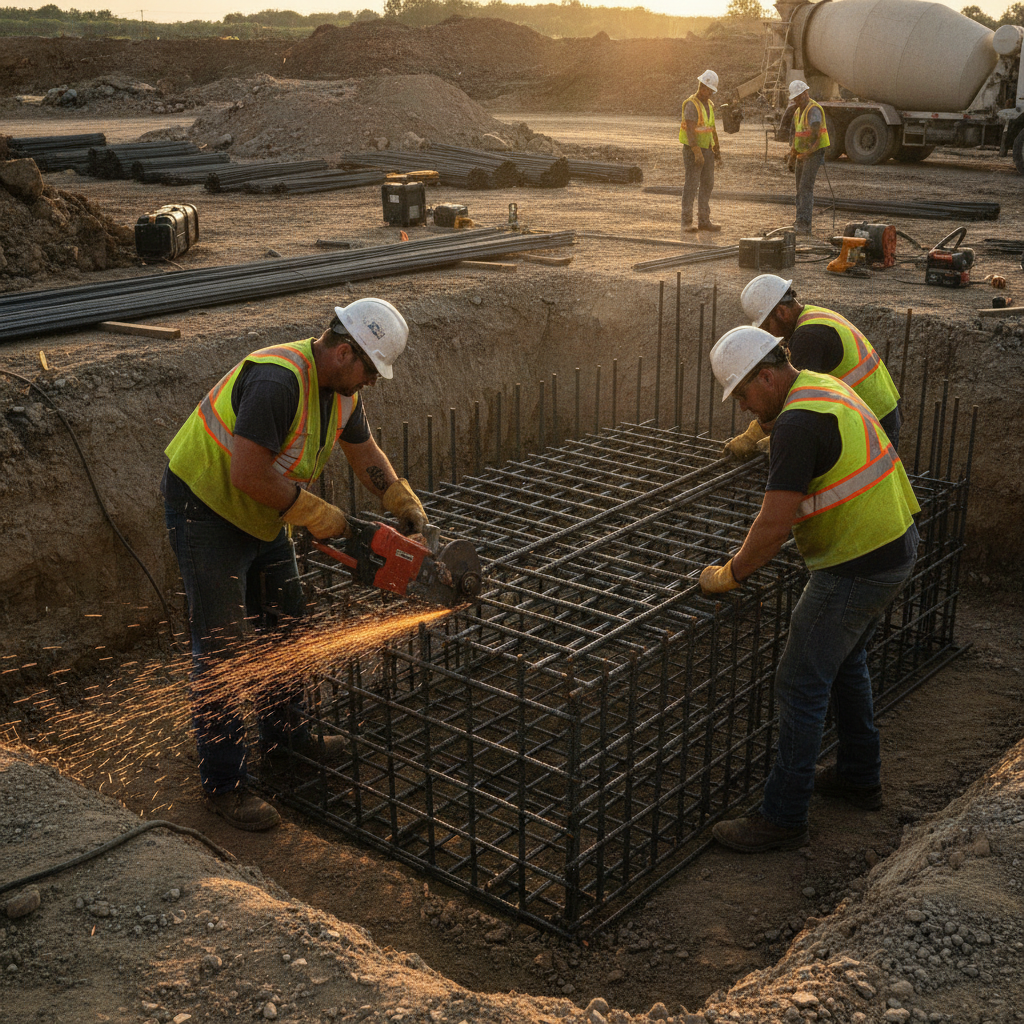
Mini case studies and rapid-fire scenarios
On Ontario projects, disciplined estimating has accelerated pours, reduced returns, and simplified inspections. These scenarios show how adjustments to laps, marks, stock lengths, and phasing changed field productivity without altering structural intent.
Residential high-rise podium (Toronto)
Podium slab with heavy 15M top/bottom mats. Strip plans revealed lap congestion at column lines. Moving lap zones by one bay reduced clashes. Fabrication delivered two phases per pour, trimming on-deck time by a full shift and keeping inspectors focused on cover and spacing.
Townhome development (Waterloo)
Repetitive wall and slab modules benefited from template-driven marks. A single spreadsheet tab duplicated per unit kept counts consistent. Returns dropped as bundles mirrored crew lift capacity, improving cycle time by ~12% across 24 units.
Mixed-use tower core (Pickering)
Core walls detailed with mechanical couplers at embed clusters. The estimator’s change log aligned with shop drawings, eliminating onsite cutting during two critical lifts and keeping crane utilization above 85%.
Rapid-fire scenarios (11 examples)
- Transfer slab: Switching to 40 ft stock reduced offcuts by ~8% compared with 20 ft stock.
- Parking deck: Staggering 15M lap zones cut tie congestion at column lines in half.
- Core walls: Couplers removed 24 in. laps at 120 splices, freeing crane time for embeds.
- Shear walls: Renumbering marks by elevation avoided cross-floor mix-ups.
- Stairs: Prebent stringer bars eliminated 90% of field bending for a stair core.
- Slab openings: Early coordination on four 4 ft x 8 ft openings prevented 20+ bar clashes.
- Edge beams: Mark-specific hooks standardized bends and sped QC checks by ~25%.
- Podium ramps: Variable spacing templates handled grade transitions without ad hoc math.
- Mat foundation: Bundle sizes matched a 2,000 lb safe lift, reducing double-handling.
- Retaining walls: Revit-based marks flagged sleeve conflicts 10 days before pour.
- PT coordination: Rebar/PT strip plans prevented 15+ tendon conflicts at anchor zones.
For a broader look at materials and sizes used on these scopes, our concrete reinforcing bar guide explains where 10M, 15M, and 20M typically land in Ontario designs.
Pricing drivers and variables (no numbers, what to watch)
Rebar estimating effort varies with drawing clarity, scope complexity, change volume, and delivery phasing. Material tonnage shifts with bar size mix, lap/coupler strategy, openings, and edge conditions. Tight schedules increase value in early estimator involvement.
- Drawing quality: Clear sections and consistent notes reduce RFI cycles by double digits.
- Complexity: Transfer slabs, cores, and irregular geometry increase mark types and BBS lines.
- Change cadence: Frequent addenda or tenant moves require re-baselining counts and marks.
- Phasing/logistics: Crane charts and street access shape bundle sizes and release plans.
Tip: Lock a revision date for estimating, then track all deltas forward. Even a four-line change register (mark, before, after, reason) keeps teams aligned and prevents “phantom” overruns.
To understand how steel readiness feeds site pace, revisit our note on delivery timing and how it stabilizes pours and inspections.
Working with a rebar partner in Ontario
Choose a partner who estimates, details, fabricates, and delivers in-house. One accountable line from takeoff to truck reduces misses. Ask for sample BBS pages, mark legends, and phasing plans that match your pour calendar.
- End-to-end capability: Estimating, detailing, project management, fabrication, delivery, and on-site assembly under one roof.
- Material options: Grade 500W/400W, epoxy-coated, GFRB, and welded wire mesh in common gauges (6x6x6/6, 9/9, 10/10).
- Logistics: Dedicated trucking with predictable arrival windows across the GTA and Ontario.
- Compliance: MTO-approved supply supports municipal and infrastructure scopes.
Ask for two things up front: a sample mark system from a similar job and a proposed bundling scheme by pour. You’ll spot gaps before they reach your deck. If you also need shop-ready inputs, our rebar drawings explainer clarifies how engineers, detailers, and estimators sync.
From Woodbridge, we support residential podiums, commercial slabs, and infrastructure placements with in-house estimating, detailing, rebar fabrication, and coordinated delivery.
Mid-article resource: Want a one-page estimating checklist? Contact our team and we’ll share the template we use to kick off every Ontario takeoff.
Frequently Asked Questions
These quick answers address how rebar estimating differs from calculators, what inputs you need, how laps affect counts, and when to bring an estimator into your schedule. Each answer is concise and field-oriented.
What’s the difference between a rebar calculator and a full estimate?
A calculator gives rough counts from simple inputs like spacing and area. A full estimate interprets drawings, adds bends, hooks, laps or couplers, and outputs a bar bending schedule with phasing. It’s the difference between a rough number and a shop-ready plan.
Which inputs do I need to start a rebar estimate?
Use the latest structural drawings, general notes, rebar schedules, and any addenda. Include pour sequence, crane access, and required inspection milestones. These details shape marks, laps, and delivery phasing more than most teams expect.
How do lap splices change quantities?
Lap splices add length per splice, commonly defined as a multiple of bar diameter (for example, 40d). More splices or larger bars mean more total length. Mechanical couplers remove lap length but add device counts—useful in congested areas.
When should I involve a rebar estimator?
Bring an estimator in as soon as structural drawings stabilize and pour sequencing is known. Early involvement reveals congestion risks, refines lap zones, and sets realistic delivery phasing so field crews aren’t waiting on steel.
Does welded wire mesh replace rebar?
Mesh can complement or replace small-diameter bars in slabs-on-grade depending on design. It’s a design decision—estimators include it when specified and coordinate sheets, sizes, and laps just like bar steel.
Conclusion and next steps
A reliable concrete rebar estimator isn’t a gadget—it’s a disciplined workflow that turns drawings into a buildable plan. When counts, marks, and phasing are right, pours land on time and inspections go smoothly. Lock your process and partner early.
- Key takeaways: Standardize inputs; define marks; account for laps/couplers; phase to pours; run a second-reader QA.
- Action step: Assemble your inputs and choose a partner who estimates, details, fabricates, and delivers in-house.
- Next move: Schedule a short scope review to align marks, bundling, and delivery to your pour calendar.
If you’re working in or around Woodbridge, our team supports rebar estimating, detailing, fabrication, and delivery across Ontario. Let’s align your bar lists to the schedule so the next pour hits its date.