
A local supply and delivery planning guide
Short answer. Plan reinforcing wire by starting with the issued design—not a product nickname—then confirm the exact designation, governing standard, sheet or roll form, quantities, required documents and approved substitutions. For a Woodbridge job, add route, booking window, truck access, unloading, laydown, bundle labels and pour sequence before dispatch. The responsible professional determines suitability; the supplier confirms the current product and commercial terms.
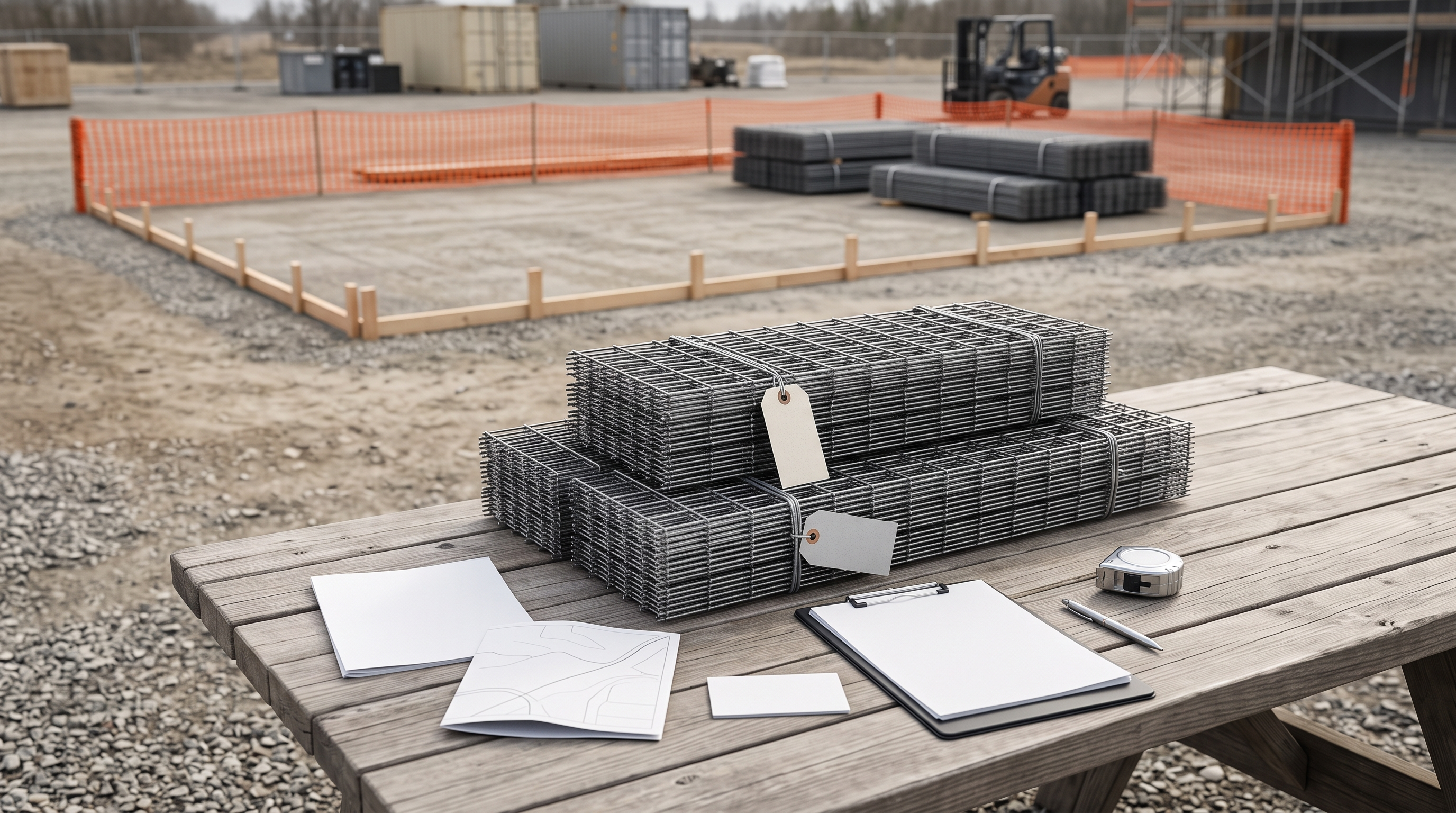
A reliable Woodbridge delivery begins with the approved designation, sequenced quantities and a confirmed unloading and laydown plan.
Start with the approved reinforcing documents
Reinforcing wire can refer to different welded wire reinforcement products and forms. An estimator should not select one from a generic article, a photograph or a remembered shorthand. Begin with the latest structural drawings, specifications, schedules, details, general notes, approved shop drawings and written clarifications.
Record the revision and issue status used for the takeoff. Highlight slab areas, construction joints, openings, edge conditions, thickened zones and details that change reinforcement. Confirm who owns the design and who may approve a substitution. If documents conflict, raise a request for information instead of choosing the most convenient interpretation.
Codes Canada publishes national model code resources, but the adopted code, project design and authority requirements for the actual Woodbridge site must be identified. This guide does not establish reinforcing requirements.
Dass Rebar’s current rebar and wire mesh article provides general category information. Use the project documents and current product data—not the blog page—as the controlling source for an order.
Confirm the exact reinforcing wire designation
Shorthand such as 6 x 6 x 6/6, 9/9 or 10/10 may appear in conversation or legacy documents. Do not assume what each number means, convert between naming systems or treat the options as interchangeable. Ask the designer and supplier to reconcile the notation with the current standard, product data and approved submittal.
| Order field | What to confirm | Why it prevents errors |
|---|---|---|
| Project designation | Exact notation copied from approved documents | Avoids informal translation |
| Referenced standard | Edition and project requirement where applicable | Defines the intended product framework |
| Material and finish | Type, coating or exposure requirement if specified | Prevents a visually similar substitution |
| Form | Sheet, roll or another approved configuration | Affects handling, layout and quantities |
| Dimensions | Approved sheet or roll dimensions and tolerances | Connects the takeoff with actual units |
| Placement details | Lap, support, cover, joints and openings | These are design and installation controls |
| Evidence | Product data, declarations, test records or certificates required by contract | Prevents documentation gaps at receipt |
The Wire Reinforcement Institute and Concrete Reinforcing Steel Institute publish industry resources. Those sources support informed coordination but do not approve a Dass Rebar product or a specific project choice.
Build a takeoff that follows the pour sequence
A single project total may be hard to receive and use. Break the takeoff into slabs, levels, phases or pour zones that match the construction schedule. Each line should retain the approved designation, form, unit dimensions, quantity and location tag.
- Freeze the drawing and specification revision used for measurement.
- Map every zone requiring welded wire reinforcement.
- Separate product designations and forms without combining similar labels.
- Apply laps, waste and openings only under the approved takeoff method.
- List supports, accessories or other materials separately where in scope.
- Group quantities by requested delivery and pour sequence.
- Identify alternates and hold them for written approval.
- Request the specified documentation with the quote.
- Reconcile purchase-order lines with the approved submittal.
- Assign bundle tags that match the site receiving plan.
Do not hide contingency inside every line. Show the measured quantity, approved allowance and spare quantity separately so the team can understand why material was ordered. When the design changes, issue a traceable takeoff revision rather than editing the old total without a record.
Dass Rebar’s current welded wire mesh content can start a product conversation. Confirm the exact current product, documentation, availability, packaging, price and commercial terms through the actual quote.
Plan the Woodbridge delivery before ordering
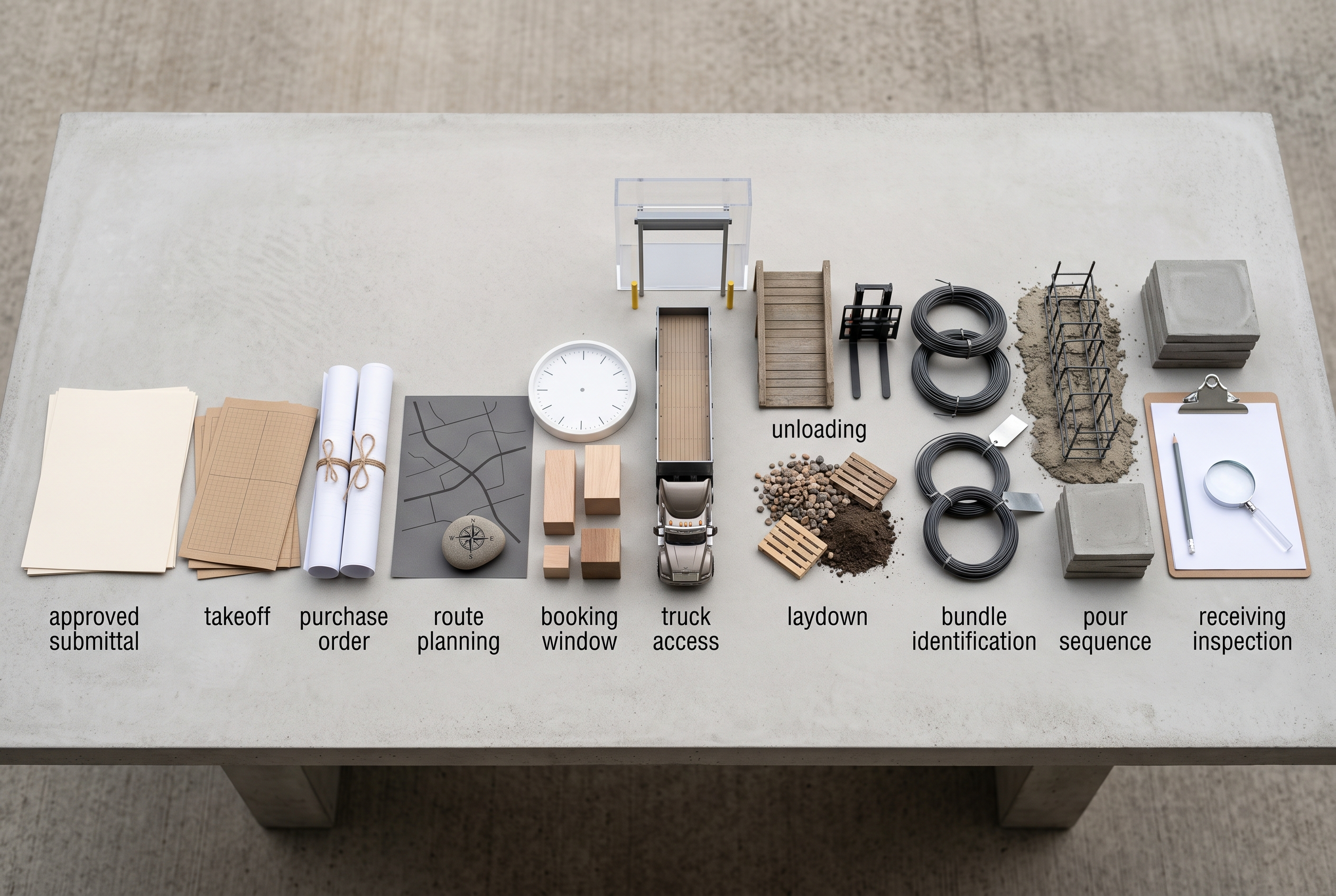
Close the information gaps before dispatch so the right material reaches the right pour area in a usable sequence.
Woodbridge jobs can involve busy industrial routes, active subdivisions, constrained commercial properties or occupied sites. The postal address alone does not tell a dispatcher whether a truck can enter, turn, wait or unload. Send a marked route and site logistics plan with the purchase order.
| Local logistics item | Information to send | Confirmation needed |
|---|---|---|
| Route | Site entrance, approved truck route and prohibited approaches | Carrier review and current road conditions |
| Booking | Date, time window, site hours and contact | Dispatch acknowledgement |
| Access | Gate, width, height, surface, turning and staging limits | Vehicle compatibility |
| Unloading | Crane, forklift or other plan and responsible party | Approved lift and equipment arrangement |
| Laydown | Level location, capacity, protection and separation by zone | Site superintendent approval |
| Sequence | Bundles by pour, floor or phase | Labels aligned with schedule |
| Restrictions | Municipal, road, noise, permit or neighbour constraints | Current project-specific check |
Ontario’s 511 service can help check current provincial road information. It does not replace municipal restrictions, permits, carrier routing or live site instructions. Reconfirm the route before dispatch, especially around closures, seasonal restrictions or major construction.
Prepare a safe receiving and laydown process
Name the site receiver and give dispatch a working contact. Before the truck arrives, confirm that the access route and laydown zone remain clear, stable and suitable for the approved unloading plan. Delivery personnel should not improvise rigging, crane reach or ground support from an article.
At receipt, compare the delivery ticket, bundle labels and physical count with the purchase order and approved schedule. Keep different designations and pour zones separated. Photograph labels and visible damage without exposing confidential site information. Quarantine unclear material until the supplier and responsible project representative resolve it.
Protect stored reinforcement as required by the project documents and product guidance. Do not move identification tags to make bundles look correct. If material is short, damaged or different, document the condition before installation and issue a written resolution.
Dass Rebar’s current website identifies its local business and reinforcing focus, but it does not make any specific delivery, unloading, inventory or jobsite result automatic. Confirm each commercial and logistics commitment in writing.
Common reinforcing wire planning mistakes
- Ordering from a nickname instead of the approved designation
- Assuming 6/6, 9/9 and 10/10 are interchangeable choices
- Using an old drawing revision after the slab layout changes
- Letting a supplier quote act as an engineering substitution approval
- Combining all pours into one quantity without bundle sequencing
- Failing to request required product documents before delivery
- Sending a truck before confirming route, access and unloading
- Mixing bundles in laydown and losing identification
- Installing unclear or damaged material before written resolution
Frequently asked questions
What does 6 x 6 reinforcing wire mean?
The notation may refer to spacing and additional product information, but naming systems and project conventions must be reconciled with the current specification, standard and supplier data. Do not decode it from a general article for ordering.
Can I substitute one welded wire mesh designation for another?
Not without the project’s formal review and approval. A similar-looking product may provide different reinforcement or fail another requirement.
Should reinforcing wire arrive in sheets or rolls?
The design, product availability, handling, placement and approved submittal determine the form. Confirm it explicitly because form affects quantities and logistics.
What should a Woodbridge delivery request include?
Include the full address, site entrance, approved route, booking window, contact, access limits, unloading responsibility, laydown zone, bundle sequence and current restrictions, alongside the exact purchase-order lines.
Request a project-specific reinforcing wire quote
Send Dass Rebar the current design references, approved designation, form, quantities by pour, required documents, delivery address, booking needs, access, unloading and laydown plan. Use the current Dass Rebar website to begin the inquiry, then confirm product, standards, documentation, availability, packaging, price, delivery and exclusions in writing. Route technical suitability and every substitution to the responsible professional.