
Steel wire mesh for concrete reinforcement is a prefabricated grid of welded steel wires that controls shrinkage cracking and improves load transfer in slabs, walls, and pavements. From our yard at 370 New Enterprise Way in Woodbridge, Dass Rebar supplies mesh in 6×6 patterns and multiple gauges to keep pours on schedule and inspections clean.
By Navjot Dass | Dass Rebar • Last updated: 2026-06-12
Overview and table of contents
Use welded steel wire mesh to speed placement, control early-age cracks, and deliver uniform reinforcement in slabs-on-grade and light structural members. This complete guide covers definitions, specs, installation steps, local delivery logistics, and how Dass Rebar supports estimating, detailing, fabrication, and trucking across Ontario.
This guide is written for general contractors, concrete crews, developers, and construction managers working across Ontario. You’ll find field-proven steps, checklists, and logistics tips based on our in-house estimating, detailing, fabrication, delivery, and on-site assembly experience.
- What welded wire reinforcement (WWR) is and how it’s specified
- Why mesh matters for slabs, sidewalks, and toppings
- How mesh works inside concrete to restrain cracks
- Types, sizes, and real-world specification choices
- Mesh vs. loose rebar and when to blend both
- Best practices and step-by-step installation
- Tools, submittals, and inspection resources
- Ontario case studies and local delivery planning
Quick summary
Welded wire mesh offers fast coverage, predictable crack control, and simpler inspections. Choose 6×6 in 6/6, 9/9, or 10/10, plan one-square laps, use continuous chairs, and coordinate delivery to match pour breaks. Dass Rebar’s in-house teams align takeoffs, shop drawings, and trucking so slabs finish on time.
In one sentence: pre-plan sheet sizes, supports, and laps; stage flatbeds to your sequence; and keep mesh at mid-depth for consistent performance. These three moves prevent most slab headaches we see on jobs across the GTA.
What is welded steel wire mesh for concrete?
Welded wire reinforcement (WWR) is a factory-welded grid of longitudinal and transverse cold-drawn steel wires. Specified by spacing and wire size (for example, 6×6 at 6/6), it restrains shrinkage and temperature movement so cracks remain narrow, protecting finishes and edges.
In practice, crews use two main formats: flat sheets and rolls. Flat 8 ft by 20 ft sheets cover 160 square feet per panel, ideal for large bays. Rolls help on long, narrow placements like sidewalks and trench caps where continuous pull is practical.
On drawings and submittals you’ll see notations like 6×6 6/6, 6×6 9/9, or 6×6 10/10. The first pair is spacing in inches; the second pair denotes wire size. Inspectors check spacing, sheet markings, lap location, and, most importantly, elevation. For an illustrated refresher, review our internal primer on welded wire mesh reinforcement.
Because one 8×20 sheet equals 160 square feet, staging ten sheets pre-covers 1,600 square feet. That simplifies pour math, pump time, and crew pacing. We routinely see smoother finishing when staging follows column lines and control-joint plans.
Terminology you’ll see on drawings
- Welded Wire Reinforcement (WWR): The technical term for welded wire mesh in codes and submittals.
- Deformed vs. plain wire: Deformed profiles increase mechanical bond; plain relies more on adhesion and confinement.
- Sheet designation: Some schedules vary wire sizes by direction; confirm orientation before placement.
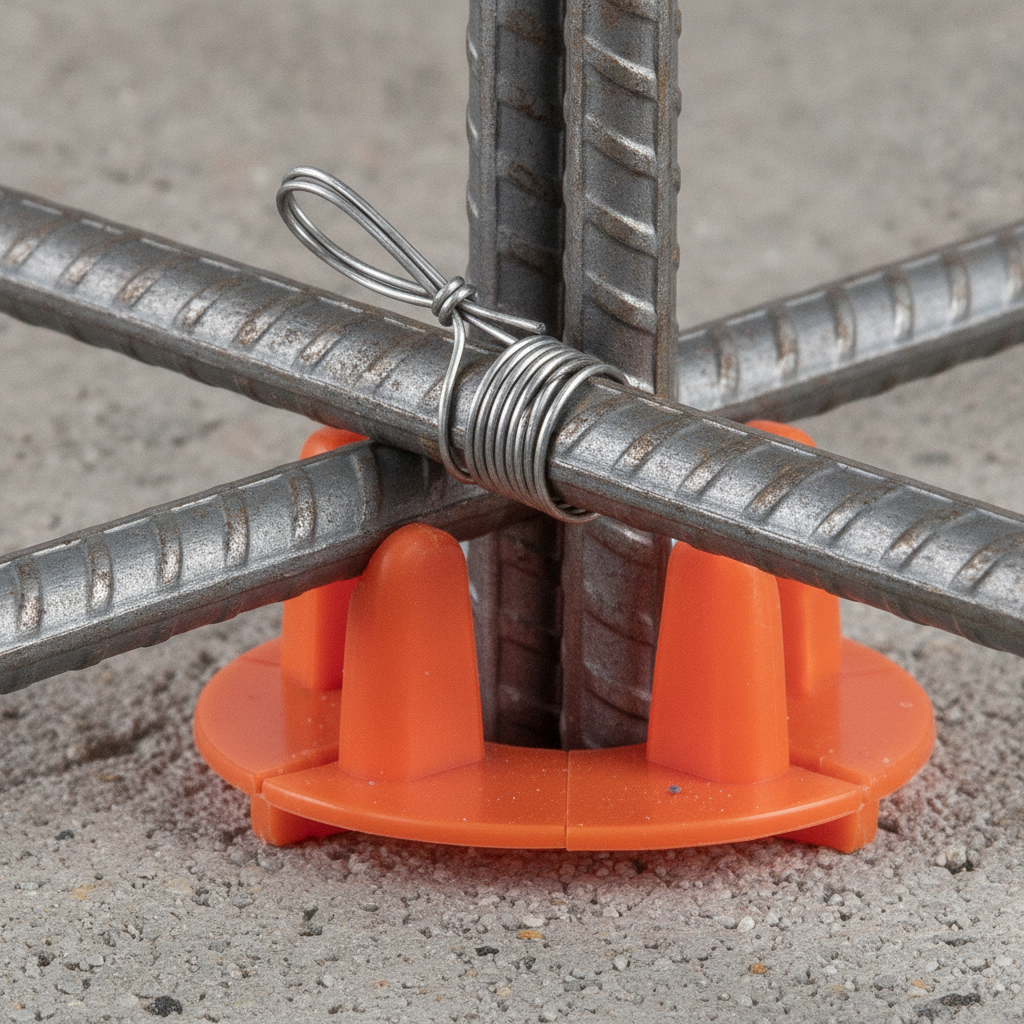
- Support chairs: Plastic or metal chairs maintain design depth. Consistent elevation is more critical than wire size for crack control.
Pro tip: note where plumbing sleeves or conduit packs intersect your mesh layout. Pre-trim sheets around dense sleeves so the grid doesn’t ride up during the pour.
Why wire mesh matters on slabs and pavements
Wire mesh distributes loads and restrains shrinkage, leading to tighter, more uniform cracks and less edge spalling. It also accelerates coverage versus tying loose bars, which reduces labor congestion and helps inspectors verify reinforcement quickly.
Here’s the thing—cracks aren’t the problem; wide cracks are. A 6-inch grid ensures any microcrack is intercepted quickly, keeping openings narrow as the slab dries and cycles with temperature. Tighter cracks preserve sealers, polished finishes, and joint arrises.
- Coverage speed: Each 8×20 sheet adds 160 square feet. Two installers can place and align a sheet in under a minute in open bays.
- Predictability: Uniform spacing means uniform restraint, so post-pour crack mapping is consistent across panels.
- Inspection efficiency: Clear markings and visible chairs help approvals move faster at pre-pour checks.
We often blend mesh in the field with bars at edges and around columns. For example, use 15M or 20M bars parallel to forklift aisles, then overlay 6×6 mesh across the bay. For a broader perspective on tensile paths, see our explainer on how rebar strengthens concrete.
How wire mesh works inside concrete
Mesh controls crack widths by tying microcracks together early and sharing tensile demand among many wires as loads increase. Close spacing redistributes stress rapidly, which limits crack opening and protects slab edges, joints, and finishes from damage.
Bond is both chemical and mechanical. Deformed wires increase interlock; plain wires rely more on adhesion. Once a crack starts, adjacent wires pick up load within a few inches, so openings remain hairline. That’s why you’ll see fewer callbacks on polished slabs when mesh sits at the correct elevation.
Elevation matters. For slabs-on-grade, aim for mid-depth with consistent chair spacing (often 3–4 feet on center, tighter at laps and traffic paths). In toppings over precast or metal deck, the designer may target the upper third. Either way, consistency beats perfection—uniform support spacing outperforms occasional “perfect” spots.
Types, sizes, and specs you’ll actually use
Most flatwork relies on 6×6 welded wire mesh in 6/6, 9/9, or 10/10. Choose flat 8×20 sheets for big pours and rolls for long, narrow runs. Plan one-square laps, continuous support, and pull-up where necessary so the grid ends up at design depth during placement.
Contractors in Ontario typically stock 6×6 6/6 for heavier slabs, 6×6 9/9 for general commercial floors, and 6×6 10/10 for sidewalks and light toppings. Residential garages may also use smaller sheets to maneuver around tight trenching. If you’re mixing bars and mesh, align schedules early—our team can help with composite shop drawings through our rebar and wire mesh planning workflow.
Where corrosion risk is high (salts, splash zones), designers often specify additional cover and high-quality concrete for mesh. For bridge or parking decks, epoxy-coated reinforcing bars are still the go-to corrosion strategy, sometimes combined with mesh in toppings. We carry both standard and epoxy-coated bars in common diameters.
Common specification notes
- Spacing: 6×6 inches is standard for slabs; other spacings show up on specialty designs.
- Wire size: 6/6 (heavier), 9/9, and 10/10 (lighter) are widely available from stock.
- Sheet size: 8 ft x 20 ft dominates commercial pours; cut sheets ease installation in tight bays.
- Supports: Use continuous high chairs or 3–4 ft O.C. chairs; add density at laps and traffic paths.
- Laps: Lap at least one full mesh square past the last cross wire unless project specs require more.
Need a refresher on product types and benefits? Our internal guide on mesh-reinforced concrete covers use-cases and typical QA checks.
Wire mesh vs. loose rebar: where each wins
Use welded wire mesh for speed and uniform crack control in slabs and toppings. Select loose rebar when you need directional strength, complex detailing, anchorage, or heavy point-load capacity. Many projects blend both: bars at edges and openings, mesh across the open field.
Think of mesh as your field-wide crack conditioner and bars as your load-path shapers. Around columns, dock pits, and heavily loaded racks, bars like 15M and 20M give you hooks, anchors, and directional stiffness. Across open spans, mesh provides the uniform restraint that keeps cracks tight and predictable. For a deeper dive into bar selection and scheduling, see our concrete rebar guide for Ontario.
| Criteria | Welded Wire Mesh | Loose Rebar (e.g., 10M–20M) |
|---|---|---|
| Placement speed | Very fast (160 sq ft per 8×20 sheet) | Slower; many ties required |
| Crack control | Excellent due to 6-inch grid | Good with proper spacing |
| Directional capacity | Balanced both ways | Customizable one-way or two-way |
| Complex details | Harder to shape around embeds | Easy to bend and hook |
| Corrosion protection | Relies on cover and concrete quality | Epoxy/stainless options common |
When in doubt, blend them. We frequently specify mesh in the field plus bars at edges and openings. Our overview on reinforcing bar vs mesh outlines typical hybrid layouts and inspection notes.
Best practices for specifying and installing mesh
Start with clear submittals, pre-cut panels for tight bays, continuous support, and a pull-up plan for rolled mesh. Focus on laps, elevation, and traffic control during placement. Document everything with photos so inspections and closeout move fast.
Successful projects follow a predictable sequence. In our experience across the GTA, the jobs that sail through inspection do four things well: align submittals early, stage sheets to the pour sequence, maintain elevation with enough chairs, and keep traffic off the supported grid.
Specification checklist
- Confirm standard conformance and capture sheet markings on submittals.
- Note 8×20 panels where feasible; call out required field cuts around dense sleeves.
- Detail lap locations away from control joints; stagger adjacent laps.
- State chair type and spacing (continuous or 3–4 ft O.C.); densify at laps.
- Define the pull-up step for rolled mesh to reach final elevation.
Installation sequence (field-proven)
- Prepare and compact the base to spec; verify grade pins and vapor retarder if required.
- Lay chairs in lines 3–4 ft O.C., tighter at laps and traffic paths.
- Stage 8×20 sheets to match the pump’s route; avoid stepping on elevated mesh.
- Lap at least one full square beyond the last cross wire; tie edges 2–3 intersections per side.
- During placement, keep buggies and pumps off the grid; use hooks to lift sheets slightly as concrete rises.
- Recheck elevation every 10–12 ft; adjust chairs promptly.
- Photograph laps, markings, and supports for the daily QA log.
For polished floors, consistent reinforcement depth helps reduce telegraphing. Tighter cracks protect densifiers and sealers, which extends maintenance intervals. Our hands-on summary in mesh-reinforced concrete guide details finishing implications.
Need help aligning drawings, deliveries, and field crews?
- Lean on our in-house estimating and detailing to resolve conflicts early.
- We coordinate fabrication, dedicated trucking, and on-site assembly when needed.
- One partner, end-to-end: fewer handoffs and faster approvals.
Tools, submittals, and resources
Your kit should include current standards, stamped shop drawings, a placement plan, and a delivery schedule. Pair that with continuous chairs, tie wire, rebar hooks, PPE, and elevation checks every 10–12 feet. Coordinated estimating, detailing, and trucking keep pours on time.
At minimum, assemble the following: reinforcement schedule with sheet sizes, chair layout with O.C. spacing, lap diagram, and a placement sequence keyed to joints. Add a delivery calendar that matches pour breaks and pump windows. For reinforcement background, see our broader reinforcing steel overview.
- Stamped shop drawings for mixed bar/mesh systems with clear laps and elevations.
- Inspection checklist: markings, spacing, laps, elevation, and photo log.
- Safety plan covering rigging, offloads, and traffic separation during placement.
- QA log template for daily pre-pour and post-pour notes.
For context on load paths and framing coordination on mixed-material projects, review this field-oriented steel frame bracing guide and companion notes on heavy gauge framing. While focused on framing, the load-path thinking carries over to slab detailing decisions.

Mini case studies from Ontario projects
Across GTA projects, crews speed slabs by staging 8×20 sheets, pre-planning laps, and blending mesh with perimeter bars. The payoff is predictable crack maps, fewer RFIs, and faster inspections—especially when shop drawings and deliveries are aligned before the first pour.
Multiresidential podium (Toronto): Mesh across open spans plus 15M bars at column strips kept pours to half-day cycles. Pre-cut sheets around dense sleeves eliminated ride-up during pumping and reduced trowel corrections by the finishing crew.
Light-industrial slab (Waterloo): 6×6 6/6 sheets with doweled joints held panel curl in check. After racking installation, forklift traffic produced only hairline cracks along control joints—exactly as designed.
Retail slab-on-grade (Pickering): Smaller pre-cut sheets improved maneuverability around plumbing trenches and sleeves. The inspector signed off in one pass thanks to clear markings, photo documentation, and consistent chair spacing.
We’ve found that pre-approval of sheet markings and confirmation photos before concrete trucks arrive reduces back-and-forth and helps inspectors document compliance efficiently. The same approach works when blending mesh with edge bars like 20M at loading docks and openings.
Wire mesh logistics in Woodbridge and the Regional Municipality of York
For Woodbridge jobs in the Regional Municipality of York, coordinate yard access, truck staging, and delivery windows to avoid bottlenecks. Dass Rebar’s proximity to Highway 50 streamlines flatbed routing, minimizing offload times and keeping pours on sequence.
Local staging rules and time-of-day restrictions affect how many sheets you can pre-stage per bay. Confirm forklift capacity, gate widths, and interior corners before dispatch. When scheduling flatbeds, pair deliveries with your pour breaks to limit on-ground stock and reduce pick cycles.
Local considerations for Woodbridge
- Staging near Highway 50 helps time flatbeds between the Highway 50 – Zum Queen Stop EB and Fogal Rd / Highway 50 area during lower-traffic windows.
- Winter pours demand chair stability and warmed enclosures; frozen subgrades can cause elevation drift and inconsistent crack restraint.
- For retail sites, plan off-hours offloads to avoid customer traffic and preserve floor-flatness prep right up to pour time.
Frequently Asked Questions
Contractors ask about laps, chairs, sheet sizes, and when to choose bars instead of mesh. These direct answers reflect common field practice so you can plan submittals, inspections, and pour-day logistics with confidence.
How is welded wire mesh specified?
Designations list spacing and wire size, such as 6×6 at 6/6, 9/9, or 10/10. Submittals should include sheet size (often 8×20), markings, and conformance to project standards. Inspectors verify spacing, laps, and elevation during placement.
Where should I place mesh in a slab?
For slabs-on-grade, aim for mid-depth using continuous or regularly spaced chairs. Keep mesh off the base and avoid driving buggies on the grid. If using rolled mesh, plan a pull-up step to reach the final elevation as concrete rises.
Is mesh better than rebar?
It depends on load paths. Mesh excels at uniform crack control and speed in open slab areas. Loose bars are better for high point loads, openings, heavy edges, or directional reinforcement. Most projects use both: bars at edges, mesh in the field.
What lap do I need for welded wire mesh?
A practical rule is at least one full mesh square past the last cross wire unless project specs state otherwise. Stagger laps and keep them away from control joints. Heavier wire sizes typically provide better crack restraint.
Key takeaways
Plan sheets, supports, and laps. Keep mesh at elevation. Blend with rebar at edges and openings. Coordinate deliveries to your pour sequence. These steps produce tighter cracks, faster inspections, and smoother finishes on Ontario jobs.
- 6×6 grids in 6/6, 9/9, or 10/10 cover most slab needs.
- One full-square lap and staggered seams limit weak planes.
- Continuous chairs or 3–4 ft O.C. spacing protect elevation.
- Blend 15M–20M bars at edges and columns for directional strength.
- Stage 8×20 sheets to match pump routes and joint plans.
Conclusion and next steps
Welded wire mesh is a fast, reliable way to control cracks and standardize slab performance. With clear specs, chairs, and a coordinated delivery plan, crews deliver consistent outcomes. Dass Rebar supports you end-to-end—estimating, detailing, fabrication, delivery, and on-site coordination.
Looking to pair mesh with bars for edges, docks, or openings? Explore our steel rebar basics and leverage our in-house detailing to align openings, sleeves, and edge bars with your field mesh. If you prefer a quick refresher that compares both systems side by side, review our bar vs mesh overview before your next pour.
Ready to plan your next slab in Woodbridge or anywhere across Ontario? Contact our team for coordinated takeoffs, shop drawings, and trucking windows that match your pour breaks. We’ll help you keep sequence, finish strong, and close out with clean documentation.