
Epoxy coated reinforcing steel is carbon-steel rebar protected with a fusion-bonded epoxy layer to slow chloride-driven corrosion in concrete. The coating isolates steel from moisture and salts, extending service life in deicing and marine exposure. From our Woodbridge yard at 370 New Enterprise Way, Dass Rebar fabricates, delivers, and supports epoxy-coated rebar across Ontario.
By Navjot Dass · Dass Rebar
Last updated: 2026-06-06
Above-Fold Summary & Table of Contents
This guide explains what epoxy-coated reinforcing steel is, why and where to use it, how the coating works, and the best practices for handling, fabrication, delivery, placement, and inspection. Use it to reduce corrosion risk, coordinate logistics, and keep Ontario projects on schedule.
What you’ll learn in minutes:
- What epoxy-coated rebar is and where it outperforms black bar
- How fusion-bonded epoxy (FBE) is applied and inspected
- Best practices for cutting, bending, transporting, storing, and tying
- How Dass Rebar’s in-house estimating, detailing, fabrication, delivery, and assembly streamline builds
- Alternatives compared (black, galvanized, stainless, GFRP) and when to choose each
At a Glance
- Primary use: bridge decks, parking structures, podium slabs, ramps, and salt-exposed concrete
- Common sizes: 10M, 15M, 20M (and others per schedule)
- Typical coating: fusion-bonded epoxy, visually green
- Key controls: coating integrity, bar spacing/cover, crack control, proper patching at cuts/abrasions
Local considerations for Woodbridge
- Coordinate truck routes near Queen St / Highway 50 for timely flatbed access during peak trade traffic.
- Winter staging: protect coated bundles from snow/ice to avoid abrasive damage and moisture entrapment.
- For tight sites around Fogal Rd / Highway 50, pre-bundle by pour sequence to minimize on-site handling.
What Is Epoxy-Coated Reinforcing Steel?
Epoxy-coated reinforcing steel is carbon-steel rebar factory-coated with a fusion-bonded epoxy film that resists chloride ingress and moisture at the steel-concrete interface. The barrier delays corrosion initiation, helping structures in deicing or marine environments maintain strength and serviceability longer.
In practical terms, you’re getting familiar steel performance with a corrosion-resisting jacket. The coating adheres to sandblasted steel, wrapping ribs and valleys for uniform protection. When detailing provides adequate cover and crack control, epoxy-coated bars help extend maintenance intervals and reduce lifecycle disruptions.
- Core concept: same mechanical strength as black bar; added barrier against salts and water.
- Where it shines: decks, ramps, podium slabs, balconies, retaining walls, and splash zones.
- Fit with Canadian sizing: 10M (~11.3 mm), 15M (~16 mm), 20M (~19.5 mm) commonly specified.
- Compatibility: ties, chairs, and accessories should be non-metallic or epoxy-coated to avoid galvanic cells.
For a refresher on bar basics, see our accessible steel rebar basics and broader reinforcing bar guide that clarify sizes, grades, and placement rules used across Ontario jobs.
Why Epoxy-Coated Rebar Matters for Ontario Projects
Epoxy-coated rebar matters because winter deicing salts, freeze–thaw cycling, and tight maintenance budgets make chloride protection essential. The coating delays corrosion, preserves bar cross-section, and helps sustain bond. Result: fewer unplanned repairs and more predictable schedules for owners and contractors.
Ontario structures face seasonal exposure from plow spray and salt-laden runoff. Concrete inevitably micro-cracks; chlorides migrate to steel and start corrosion. With epoxy-coated reinforcing steel acting as a barrier, corrosion onset slows, which supports long-term capacity and aesthetics (no rust-staining) while minimizing disruptive repairs.
- Lifecycle value: longer intervals before repairs, fewer closures on decks and ramps.
- Risk control: less chance of spalling from expansive corrosion products.
- Schedule predictability: reduced emergency work; better alignment with planned maintenance windows.
- Code alignment: supports durability provisions when chloride exposure is anticipated.
For teams comparing options, our epoxy rebar overview and focused look at the benefits of epoxy-coated rebar outline where epoxy makes the most sense versus other strategies.
How Fusion-Bonded Epoxy Coating Works
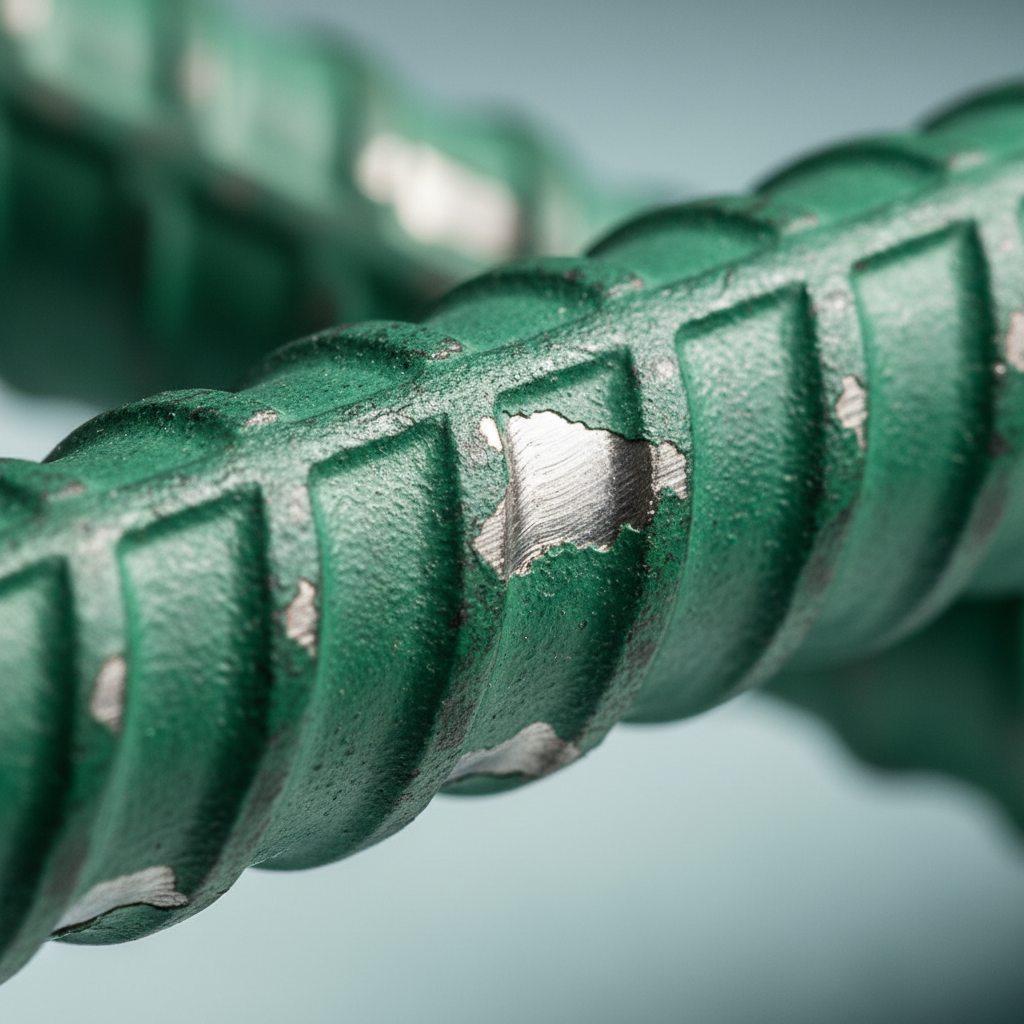
Fusion-bonded epoxy (FBE) is electrostatically applied to preheated, grit-cleaned bars. The powder melts, flows, and chemically cures into a continuous film that adheres around ribs. Proper thickness, cure, and holiday (pin-hole) control are essential to performance.
The coating process is deliberate and quality-controlled. Steel is blast-cleaned to a near-white profile, heated, and passed through an electrostatic booth. Powder particles fuse on contact, then the coated bar is post-cured and cooled. Coating integrity is verified by holiday detection and visual checks for continuity, thickness, and damage.
- Surface prep: abrasive blast to create an anchor profile and remove mill scale.
- Heat + spray: bars heated; epoxy powder sprayed via electrostatics for coverage.
- Flow + cure: resin melts and crosslinks to form a tough, adherent film.
- Inspection: look for holidays, thickness uniformity, adhesion, and damage at handling points.
Detailing and placement still rule performance. Adequate concrete cover, control joints, drainage, and crack management work with the coating to delay chloride reach. Where cuts or abrasions occur, patch with compatible epoxy to maintain the barrier.
Types, Methods, and Alternatives
Epoxy-coated rebar is one of several corrosion-protection strategies. Alternatives include black bar with sealers, galvanized bar, stainless rebar, and GFRP. Select based on exposure, structural demands, temperature limits, constructability, and lifecycle targets.
Common approaches
- Black bar + concrete durability: increase cover, use low-permeability mixes, and sealers; relies on concrete quality.
- Epoxy-coated bar: barrier protection at steel surface; familiar handling with specific care requirements.
- Galvanized steel: sacrificial zinc layer; robust but different bond and detailing nuances.
- Stainless rebar: excellent corrosion resistance; used selectively in most aggressive zones.
- GFRP (glass fiber): non-corroding; different modulus and design rules; insulation from electrical/magnetic fields.
Comparison at a glance
| Option | Corrosion Defense | Bond/Design | Constructability | Typical Uses |
|---|---|---|---|---|
| Black Bar | None; relies on concrete quality | Standard | Standard handling | Low-exposure interiors |
| Epoxy-Coated | Barrier at steel surface | Standard with care for coating | Familiar; requires protection from abrasion | Decks, ramps, podiums |
| Galvanized | Sacrificial zinc layer | Slightly different properties | Robust; careful welding rules | Marine, splash zones |
| Stainless | Excellent inherent resistance | Similar bond; higher ductility alloys | Handled like black/galvanized | High-value hot spots |
| GFRP | Non-corroding composite | Different modulus and anchorage | Cut with composite methods | Magnetic-sensitive or severe chloride |
Need help matching approach to exposure classes and constructability? Our team can walk placements, review drawings, and suggest options early so schedules hold.
Best Practices for Fabrication, Logistics, and Placement
Protect the coating, plan the logistics, and document inspections. Use coated/non-metallic accessories, padded slings, proper storage, careful bending/cutting, patch kits, and QA forms. These steps keep the barrier intact from yard to pour.
Fabrication and shop handling
- Cutting: use clean blades; remove burrs; patch exposed steel promptly with approved epoxy.
- Bending: use mandrels sized for coated bars; check for cracks in the coating; patch as needed.
- Shop flow: minimize transfers; use padded rollers and coated racks to avoid abrasion.
Loading, transport, and delivery
- Bundle protection: separators and strapping that won’t cut the coating; avoid chain bite.
- Flatbed prep: timber dunnage; edge guards; tarps when needed for road spray.
- Site offload: nylon slings; spotters; set on non-metallic cribbing above standing water.
For an overview of our logistics program, see how we coordinate rebar fabrication with deliveries to keep pours on pace.
On-site storage and staging
- Elevation: store on plastic/wood dunnage; slope tarps to shed water.
- Segregation: keep coated and black bar separate to avoid cross-abrasion.
- Weather: cover in winter precipitation; clear ice before moving bundles.
Placement, tying, and accessories
- Tie wire: use epoxy-coated or plastic ties to prevent dissimilar-metal contact points.
- Chairs/spacers: use plastic or epoxy-coated supports to maintain cover without scraping.
- Clear cover: follow drawings and exposure class; verify with pre-pour checks.
Inspection, patching, and documentation
- Holiday checks: scan suspect areas; mark and patch defects.
- Patching: clean and dry surface; apply compatible epoxy; confirm complete encapsulation.
- Records: log bar lists, delivery tickets, coating checks, and repairs for turnover packages.
Tools and Resources You Can Use
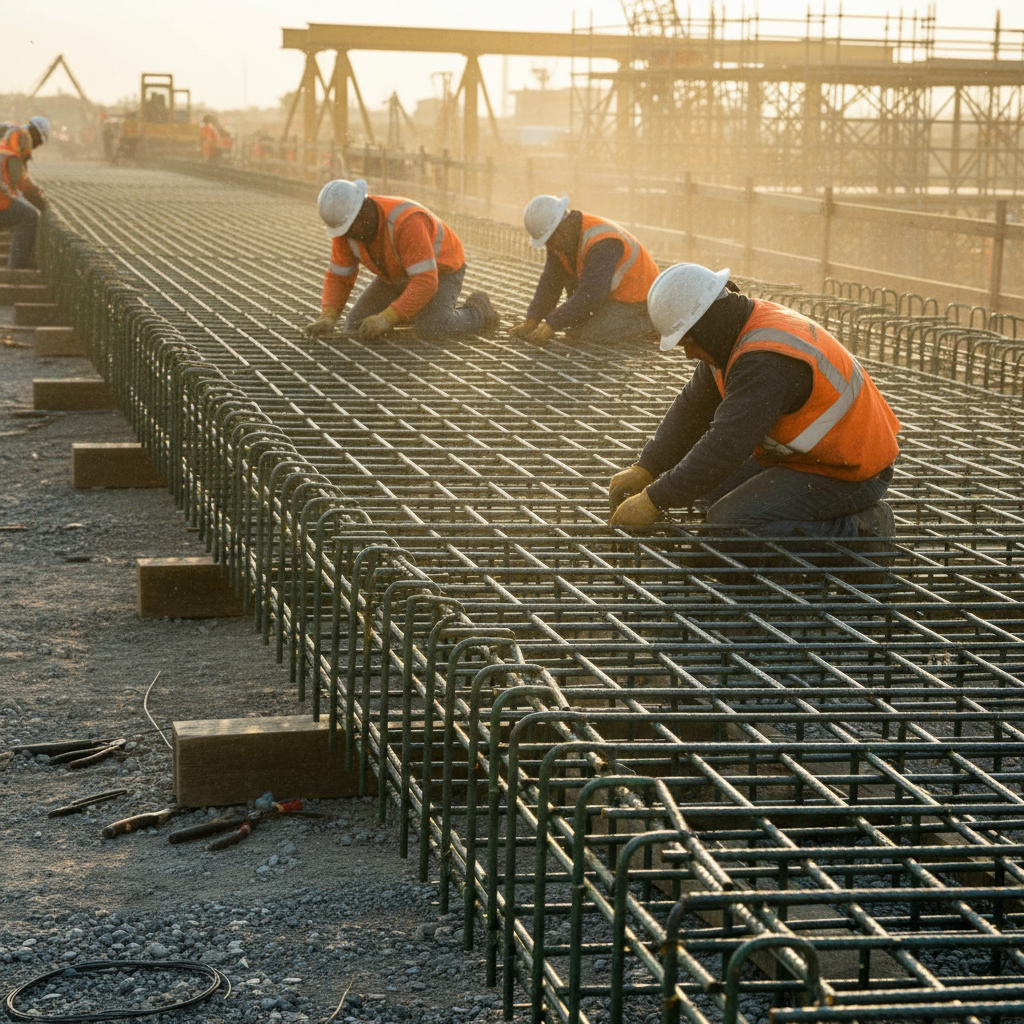
Leverage in-house services for speed and accuracy: estimating, detailing, fabrication, delivery, and assembly. Then use simple checklists, patch kits, and QA logs on site. Together, these tools protect coating integrity and schedule.
- Estimating and takeoffs: in-house quantities, alternates, and phasing to lock scopes and reduce surprises.
- Detailing and shop drawings: coordinated bar lists and bend schedules that consider coated bar handling.
- Fabrication: cutting and bending with coating-aware processes and trained handlers.
- Delivery and assembly: dedicated trucking fleet and on-site support to sequence cages by pour.
Browse practical primers like our steel rebar basics and epoxy-focused notes in our benefits of epoxy-coated rebar. For allied metal products beyond rebar, see the broader rebar products overview in our group’s network.
If welded wire reinforcement is part of your slab strategy, this explainer on wire mesh types and uses helps align mesh sheets with bars in the same pour plan.
Local Specs and Logistics in Woodbridge and the Regional Municipality of York
In Woodbridge and the Regional Municipality of York, epoxy-coated rebar supports winter-salt durability targets on decks, ramps, and podiums. Proactive staging at our 370 New Enterprise Way yard allows sequenced deliveries through dense corridors while protecting coating integrity.
We balance exposure class requirements with constructability. On tight urban jobs, we pre-bundle by elevation and pour break, label cages clearly, and time arrivals to crane windows. Our team can also walk the formwork to verify chairs and cover, reducing last-minute stress for supers.
- Neighborhood routing: plan flatbed timing around commuter peaks to reduce idle on access roads.
- Winter prep: snow events demand tarped staging and dry patch surfaces; we coordinate ahead of fronts.
- Communication: daily check-ins keep fabrications synced to field progress; fewer rehandles, fewer coating touch-ups.
Case Studies and Field Examples
Real Ontario projects show how epoxy-coated reinforcing steel pays off: tighter schedules, fewer change orders for corrosion mitigation accessories, and smoother inspections. These examples mirror common GTA exposures and jobsite constraints.
High-rise podium slab, Toronto
- Challenge: salt spray from adjacent ramps increased chloride load near podium edges.
- Approach: epoxy-coated perimeter bars, non-metallic chairs, careful cover checks.
- Outcome: clean inspection, no rework on coating, pour proceeded as scheduled.
Parking structure, Waterloo
- Challenge: heavy winter exposure and ponding risk at transitions.
- Approach: epoxy bars in drive lanes, patch kits staged with crew leads, daily QA logs.
- Outcome: documented protection at all penetrations, smooth sign-off.
Transit-adjacent podium, Pickering
- Challenge: constrained laydown; sequencing was the bottleneck.
- Approach: pre-tied cages delivered “just in time” and lifted straight to forms.
- Outcome: minimized handling and coating abrasion; consistent progress by pour break.
For deeper context on material choices and staging, our steel reinforcement options guide and epoxy rebar overview offer practical planning checklists.
Frequently Asked Questions
Here are concise answers to common questions about epoxy-coated rebar: how it differs from black bar, where to use it, how to handle it, and how Dass Rebar supports takeoffs, fabrication, delivery, and on-site assembly across Ontario.
Where should epoxy-coated rebar be specified?
Use it anywhere chlorides are expected: bridge decks, ramps, podium slabs, balconies, retaining walls, and splash zones. It’s especially useful near deicing operations and in areas with poor drainage or ponding risk.
Can coated bars be cut and bent?
Yes. Fabricate with coating-aware methods, then patch any exposed steel at cuts or abrasions with compatible epoxy. Verify bends for coating cracks and repair before placement to maintain barrier continuity.
Do I need special chairs and tie wire?
Use plastic or epoxy-coated chairs and tie wire to avoid bare steel contact points that could create galvanic cells. This small change reduces coating damage during tying and maintains the protection system.
How does epoxy-coated rebar compare with GFRP?
GFRP doesn’t corrode, but it behaves differently in design and construction (lower modulus, unique anchorage, and cutting methods). Epoxy-coated steel retains familiar steel behavior while adding a corrosion barrier. Choose based on structural demands and exposure.
What internal services support epoxy projects?
Dass Rebar provides in-house estimating, detailing, fabrication, delivery with a dedicated fleet, and on-site assembly. Coordinated project management helps keep coating intact and pours on schedule across Ontario.
Conclusion and Next Steps
Epoxy-coated reinforcing steel offers a practical, familiar path to longer-lasting concrete in salt-exposed environments. Plan the details, protect the coating, and document inspections—then let coordinated fabrication and delivery keep the schedule intact.
Key takeaways
- Epoxy-coated rebar is steel with a durable barrier that delays corrosion in chloride exposure.
- Performance relies on detailing, cover, crack control, accessories, and careful handling.
- Sequenced fabrication and delivery reduce rehandles and coating touch-ups.
- Alternatives (galvanized, stainless, GFRP) have niches; select by exposure and design needs.
Action steps
- Share drawings for a fast epoxy rebar takeoff and alternates.
- Confirm accessories: non-metallic chairs and coated tie wire on the PO.
- Align delivery windows to crane time and pour sequence.
- Prepare patch kits and a simple QA log for field leaders.
Ready to plan your next epoxy package? Explore our practical epoxy rebar overview and the 10M rebar uses article, then send us your latest drawings. We’ll coordinate estimating, detailing, fabrication, delivery, and assembly from Woodbridge.